Cointelegraph has experienced a significant decline in traffic from Google search queries, according to data from Ahrefs and SEMrush. SEMrush charts indicate an estimated 65% drop in organic traffic, while Ahrefs data shows a sharper decline of around 98%. The drop in search visibility is so significant that even a direct Google search for “Cointelegraph” no longer lists the website among the top results.
According to an article by Crypto.news, the decline was linked to Google’s August–September Spam Update, which the author described as part of a broader algorithmic shift affecting crypto publications. The article suggests that Cointelegraph’s visibility loss was consistent with a domain-wide algorithmic devaluation under Google’s updated spam and quality classifiers.
However, upon examining the data from Ahrefs and SEMrush, we found a different story. While fluctuations in the news media outlet traffic were visible throughout 2025, the sharp downturn began around October 6, over two weeks after the Spam Update concluded on September 21. This timing suggests that Cointelegraph may have been affected by a manual penalty.
The situation follows a December 2024 investigative report by SEO expert Timothy Malmros, which alleged that Cointelegraph’s iGaming section may have been operated by a third party, potentially constituting reputation abuse. Nearly a year later, following the decline in traffic, Cointelegraph removed its entire iGaming section, according to archival records from the Internet Archive’s Wayback Machine.
Data from SEO analytics platforms reveal a dramatic fall in Cointelegraph’s organic visibility beginning in October 2025. This suggests an abrupt loss of ranking signals rather than a gradual algorithmic adjustment.
According to Ahrefs, Cointelegraph’s organic traffic remained relatively stable, albeit with a mild decline for much of the year, before experiencing a significant drop around October 6, decreasing from roughly 3.5 million to just 57,215 monthly visits. Similar to Ahrefs, SEMrush data show a traffic drop starting on October 6; however, according to the analytics tool, it began with mobile devices and only later spread to desktops, resulting in a traffic drop from over 6 million visitors to 2.2 million.
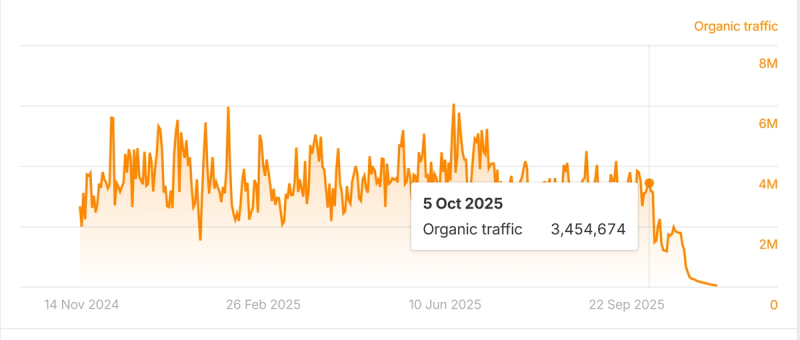

Despite differences in magnitude, both tools point to the same conclusion: the traffic collapse began in October, several weeks after Google’s Spam Update concluded on September 21. The timing strengthens the possibility that the event was caused by a manual penalty rather than a delayed algorithmic effect
A manual action is a targeted intervention by Google’s review team, typically applied when a site violates search quality or spam policies. It can result in an immediate and severe visibility loss, similar to what Cointelegraph’s charts now display. While algorithmic penalties, or automated de-rankings triggered by updates, can occur, they are typically gradual and align closely with the rollout period of the update. Cointelegraph’s traffic trend, beginning weeks after the update ended, appears inconsistent with that pattern.
This timing suggests the drop may not stem directly from the August–September Spam Update, but rather from subsequent manual enforcement or indexing adjustments related to content quality, affiliate practices, or external linking structures. The severity and immediacy of the decline reinforce the possibility of a manual demotion rather than an algorithmic shift, though Google has issued no public comment confirming such an action.
The context becomes even more significant when examining Cointelegraph’s content decisions during the same period.
Cointelegraph previously operated an active iGaming section, regularly publishing articles related to online gambling, betting platforms, and casino reviews. The section included content such as “Best Casinos Without Cruks 2025 – Anonymous and Safe Gambling” (in Dutch) and “Best Casino Apps in 2025: Top US Casino Gambling Apps”, both of which have since been removed. Today, the entire Gaming category returns 404 errors, indicating that the news outlet has entirely removed the section.
Using the Wayback Machine to analyze historical snapshots, the last archived scans of these pages provide a clear timeline of the iGaming section’s activity. The Dutch-language casino guide was last captured on October 1, 2025; the main iGaming lobby page was captured on October 12, and the "Best MLB Betting Sites and Apps in the USA 2025" page was captured on October 7. The last recorded scan under the iGaming directory was on October 12, indicating that the section was likely removed shortly after that date.


The removal of the iGaming section followed the beginning of Cointelegraph’s sharp decline in Google traffic. Cointelegraph has issued no public comment or clarification linking the two events. If Cointelegraph had noticed a suspicious traffic drop during the Google Spam Update, which concluded on September 21, it likely would have removed the iGaming section earlier.
The timing supports the view that Cointelegraph’s de-indexing began roughly two weeks after the Google Spam Update concluded, making it even more likely that it was unrelated to the algorithm update and instead consistent with a manual penalty or another form of search quality enforcement. While Google’s manual actions are rare, they can result in immediate de-indexing or demotion of entire site sections when policy violations are detected.
Cointelegraph's iGaming section was also referenced in a December 2024 investigation by SEO expert Timothy Malmros, who alleged potential SEO manipulation and third-party content syndication involving Cointelegraph’s gambling-related pages. His report suggested that the section may have been operated externally, leveraging Cointelegraph’s domain authority to rank iGaming and casino content. Though the article has since been deleted, its findings remain relevant in understanding why Cointelegraph’s gambling and betting pages may have come under Google’s scrutiny.
The disappearance of the entire iGaming directory, coupled with Cointelegraph’s 98% traffic loss (according to Ahrefs) beginning two weeks after the Spam Update concluded, reinforces the theory that the media outlet may have faced manual enforcement or compliance actions affecting its search visibility.
The Cointelegraph case reflects a broader pattern affecting crypto and finance websites under Google’s updated E-E-A-T (Experience, Expertise, Authoritativeness, and Trustworthiness) and YMYL (Your Money or Your Life) standards. The 2025 algorithm and manual review adjustments placed stronger emphasis on trust, author identity, and content reliability, while penalizing affiliate-heavy or externally managed content categories such as iGaming and crypto betting.
Under these tightened standards, affiliate-heavy content and externally managed categories, such as iGaming, are treated as higher-risk areas, making them more susceptible to manual actions or ranking suppression. The removal of the iGaming section suggests that Cointelegraph identified gambling-related content as a potential factor in its penalty and took action to reduce further risk.
Cointelegraph’s situation underscores challenges now facing many crypto publishers as Google enforces stricter YMYL and E-E-A-T standards. BeInCrypto CEO Alena Afanaseva addressed this in a LinkedIn post, describing Cointelegraph’s decline as part of a broader struggle for crypto media and warning that algorithm updates can erase years of growth. She noted that, in her view, the issue goes beyond Google’s algorithms, pointing out that operating in “grey zones of gambling and memecoins” exposes publishers to higher risk under Google’s quality rules. Afanaseva further highlighted that building sustainable, Web3-native community models remains difficult, raising questions about how publishers can adapt to future search volatility.
The Cointelegraph case follows a familiar trend observed across major publishers, where Google penalties prompt immediate content removals or restructuring efforts aimed at restoring compliance with Google's guidelines. It reflects ongoing tension between crypto media business models and Google’s tightening quality standards rather than a new shift in how enforcement operates.
Additionally, as Google continues to refine its quality policies, crypto outlets are increasingly turning to social platforms such as Facebook, X, and LinkedIn, as well as building newsletters, communities, and other direct audience channels, to reduce their reliance on search visibility and prepare for future shifts in traffic sources. Whether and to what effect these adjustments can restore lost visibility or signal a lasting realignment of crypto media strategy remains an open question.
While Google’s enforcement methods may warrant criticism for their lack of transparency and the collateral impact on crypto media, the situation with Cointelegraph also highlights the responsibility that comes with domain authority. Search penalties, whether algorithmic or manual, are often designed to protect users from reputation extension — cases where trusted brands leverage their credibility in unrelated or higher-risk sectors such as iGaming, betting, or affiliate-driven promotions.
The Cointelegraph case illustrates how even established media outlets can become vulnerable when their editorial direction strays from their core expertise. For crypto publishers, the real takeaway extends beyond SEO recovery. Protecting long-term credibility means ensuring that revenue strategies do not compromise editorial focus or trust signals.
Diversifying traffic sources, cultivating direct reader relationships, and maintaining a clear separation between journalism and promotion are not just growth tactics, but also safeguards. In an industry where both Google and audiences constantly evaluate authenticity, maintaining a clear identity and mission remains the most reliable defense against penalties and reputational loss.
0 Comments