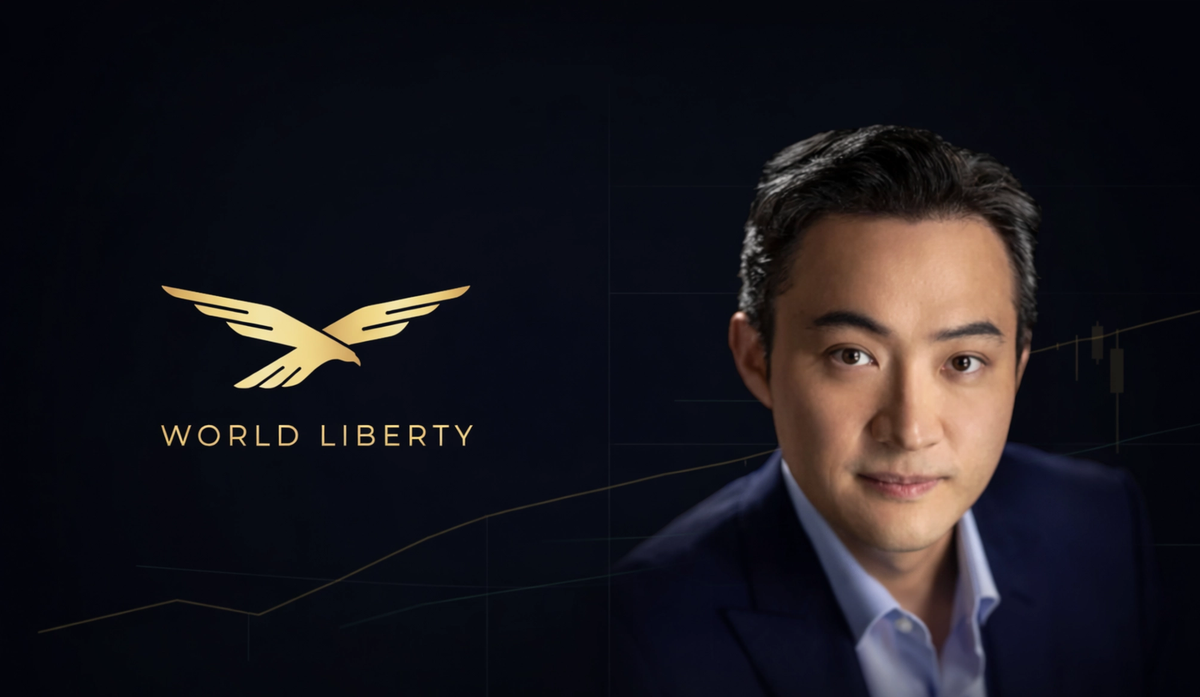
Tron founder Justin Sun publicly turned on World Liberty Financial (WLFI) this weekend, calling on the Trump-backed DeFi project to disclose who controls a single anonymous wallet that, according to on-chain data, has the unilateral power to freeze any token holder's assets.
The dispute, already months in the making, escalated across X over two days after Sun publicly accused WLFI of embedding hidden controls in its smart contract, drawing a "see you in court" response from the project and an independent on-chain breakdown that backed several of his claims.
Who Is Justin Sun and How Did He End Up at the Center of a Trump-Linked Crypto Feud
Justin Sun is a Chinese-born crypto billionaire, best known as the founder of TRON, a blockchain network associated with the Tronix (TRX) token. He also owns crypto exchanges Poloniex and HTX, and previously served as Grenada's Permanent Representative to the World Trade Organization.
In March 2023, the SEC filed suit against Sun, alleging that he and his companies had engaged in fraudulent wash trading to inflate TRX’s price, and that he paid celebrities, including Lindsay Lohan, Jake Paul, and Soulja Boy, to promote his tokens without disclosing that they were compensated. The SEC dismissed all charges against Sun in March 2026 following a settlement in which a Tron-affiliated company, Rainberry Inc., paid a $10 million penalty.
Sun entered the WLFI picture in November 2024, when he invested $30 million into World Liberty Financial's token sale, at that point accounting for 57% of all WLFI tokens sold. He later added another $45 million, bringing his total investment to $75 million through Tron DAO. In return, World Liberty Financial named Sun an advisor to the project.
World Liberty Financial was founded in 2024 by Zachary Folkman, Chase Herro, Alex Witkoff, Zach Witkoff, and members of the Trump family. The Trump family receives 75% of net proceeds from WLFI token sales, as well as a share of stablecoin profits. The project was presented to investors as a decentralized finance platform promoting financial freedom and open access to DeFi products. Sun was among its most vocal early backers.
Back in February 2025, World Liberty executives were publicly crediting Sun with generating the interest that enabled the project to meet its early fundraising goals.
Less than a year later, the two parties were threatening each other in court.
From Freezing Sun's Wallet to a Full Public Breakdown, What Went Wrong
The dispute traces back to September 4, 2025, when WLFI's controlling address blacklisted a wallet linked to Sun. The action followed on-chain transfers of $9 million in WLFI from Sun’s address, including transfers routed through HTX. At the time, the freeze affected 595 million unlocked WLFI tokens, worth about $107 million, as well as billions more in locked tokens.
Sun responded by calling the transfers mere "exchange deposit tests" and insisting no buying or selling was involved. WLFI never publicly explained the blacklist in detail, though a spokesperson later framed the action as part of a broader security response tied to a phishing incident affecting 272 wallets, and said Sun's wallet was flagged under a category described as suspected misappropriation of other holders' funds, an allegation he has consistently denied.
WLFI is currently trading near $0.082, down more than 72% from its all-time high of $0.30 set last September, and Sun's frozen stake is now worth under $50 million. His losses on the frozen tranche alone are estimated at more than $80 million.
How the Public Confrontation Unfolded Over 24 Hours
Sun fired first on April 12, posting a statement accusing WLFI of embedding an undisclosed blacklist function in its smart contract, granting the company unilateral power to freeze any token holder's assets without notice or recourse.
He called it "a trap door marketed as an open door," said the governance votes used to justify the freezes were neither fair nor transparent, and described himself as "the first and single largest victim" of the blacklist.
He was careful not to direct his criticism at Trump personally, opening by reaffirming support for "President Trump and his crypto friendly policy" and targeting what he called "the bad actors at WLFI."
WLFI responded later the same day, accusing Sun of "playing the victim while making baseless allegations to cover up his own misconduct" and ending with "See you in court pal." The post drew millions of views.
Sun replied in the comments within 30 minutes, demanding that whoever was running the official account identify themselves by name.
The On-Chain Breakdown That Fueled the April 12 Escalation
On April 12, as Sun's dispute with WLFI escalated, Banteg, the pseudonymous lead developer at Yearn Finance, published a point-by-point on-chain breakdown of the WLFI smart contract history, adding a layer of independent on-chain evidence to Sun's claims.
According to Banteg, the original WLFI token, deployed in September 2024, had no blacklist and no seizure function. The blacklist was added on August 24, 2025, eleven months after Sun invested and one week before trading opened. A November 2025 upgrade then added batch reallocation, effectively giving WLFI the ability to seize tokens outright, which the team justified as a tool to recover phished funds.
Sun was also placed in a dedicated "category 3" in the vesting contract, separate from all 519 other investors who sit in category 1. Fourteen minutes before he activated his wallet at the token generation event (TGE), WLFI's 3-of-5 multisig updated Sun’s configuration to release 20% of his 3 billion token allocation at TGE. Over the next three days, Sun transferred out 55 million WLFI.
Then, a guardian EOA (Externally Owned Account) blacklisted him. Banteg’s findings revealed that one anonymous individual can freeze any token holder’s wallet without additional approval. Additionally, that same multisig has put 5 billion WLFI as collateral on Dolomite to borrow $250 million in stablecoins, representing 86% of the protocol's entire borrow volume.
Sun’s Detailed Allegations Against WLFI
He then retweeted banteg's breakdown and added his own statement, calling the blacklist function "a trap door marketed as an open door" and saying it was never disclosed to investors.
He challenged the governance votes WLFI has cited to justify its actions, arguing that key information was withheld from voters and outcomes were predetermined. On the broader governance structure, he wrote: "Community governance and voting are meaningless. Every proposal, every vote, every claim of decentralized decision-making is theater."
On April 13, Sun retweeted Banteg's analysis and made a specific public demand: that WLFI disclose who controls the single guardian EOA and the 3-of-5 multisig governing the smart contract. Based on what on-chain records showed, he said one anonymous individual controls an address that sits on the multisig and is the sole owner of a second guardian Safe with a signing threshold of 1, meaning that person alone can freeze any token holder's wallet without a vote, while seizing assets requires the full multisig.
He called the entire governance framework "theater" and said that if WLFI had nothing to hide, identifying who controls those keys should be straightforward.
The Dolomite Position and Why It Raised Separate Concerns
The confrontation arrived days after WLFI's token hit a record low, following revelations that the project had borrowed $75 million in stablecoins on Dolomite using its own governance token as collateral.
Blockchain data showed the project borrowed the amount in stablecoins, including USDC and USD1. More than $40 million of those funds were later moved to Coinbase Prime. The borrowing structure drew criticism because Dolomite co-founder Corey Caplan also serves as WLFI's chief technology officer.
At its peak, the USD1 pool on Dolomite reached 100% utilization, temporarily locking out ordinary stablecoin depositors from their funds. WLFI defended the move, saying it serves as an “anchor” borrower in the system and that it was "nowhere near liquidation."
The revelation of the Dolomite loans, combined with the renewed public dispute with Justin Sun, triggered a wave of selling pressure that erased more than $700 million from World Liberty Financial's market capitalization, dragging its valuation from $3.20 billion to a low of $2.46 billion.