
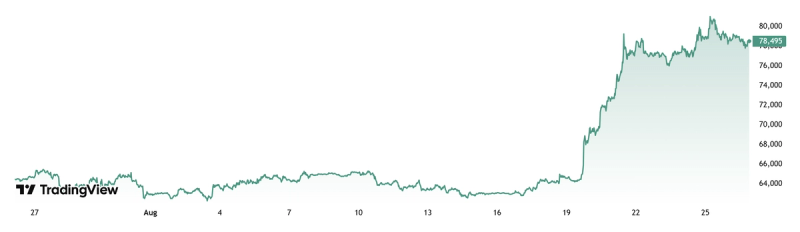
Bitcoin has gained 19% over the past month, climbing from a July 26 close of $65,440 to trade near $78,000 on August 26. BTC broke above $80,000 on August 25 and reached $81,231, its highest level in more than three months, before pulling back. Most of the monthly gain came over the past week, with Bitcoin rising more than $12,000 after August 19.
Bitcoin gained 5% on August 20, and another 7% on August 21 as spot-market demand increased and leveraged short positions were forced out. The move followed several weeks in which Bitcoin traded largely between $62,000 and $65,000.
The rally now faces several macroeconomic, regulatory, and market catalysts that could determine whether Bitcoin holds its recent gains or gives back part of the move.
Five factors are likely to have the largest effect on its short-term performance.
Federal Reserve Policy Returns to Focus Before September Meeting
The Federal Reserve kept the federal funds rate at 3.50% to 3.75% on July 29, but three members of the Federal Open Market Committee voted for a 25-basis-point increase.
Beth Hammack, Neel Kashkari and Lorie Logan supported higher rates, while the other nine voting members backed keeping rates unchanged. The Fed's next policy meeting is scheduled for September 15 and 16.
Inflation is one of the main factors behind that decision. The Bureau of Economic Analysis said on August 26 that the PCE price index increased 3.7% from a year earlier in July. Core PCE, which excludes food and energy, increased 3.3%.
Both remain above the Fed’s 2% inflation target, supporting chances for an interest rate hike.
Higher rate expectations can pressure Bitcoin by supporting Treasury yields and the dollar while making lower-risk assets more attractive. Softer inflation or signs that the Fed is moving away from another increase would create a more favorable liquidity environment for Bitcoin.
The September Fed meeting is therefore one of the largest scheduled events facing Bitcoin over the next three weeks.
Spot Bitcoin ETFs Return to Heavy Buying
U.S. spot Bitcoin ETFs have recorded a sharp change in flows during the second half of August.
The funds recorded net inflows on seven consecutive trading days between August 17 and August 25, according to Farside Investors data. Combined net inflows reached $2.57 billion during the period.
August 20 produced the largest daily figure in that run, with $606.3 million entering the funds. Another $517.2 million entered on August 19, followed by $307.5 million on August 21, $337.6 million on August 24 and $314.3 million on August 25.
That followed a weaker period earlier in the month. The ETFs recorded net outflows of $144.6 million on August 10, $61.1 million on August 12, $131.1 million on August 13, and $56.2 million on August 14.
The reversal matters because ETF flows create direct demand for Bitcoin. Continued inflows would give the market another source of buying after the recent rally, while a return to sustained outflows would remove part of that support.
ETF flows are also available every trading day, making them one of the clearest indicators of whether institutional demand is continuing after Bitcoin's move above $80,000.
Treasury Buybacks Put Yields and the Dollar in the Bitcoin Trade
The U.S. Treasury announced on August 19 that it will increase the maximum size of its liquidity-support buybacks for long-dated Treasury securities.
The maximum for operations covering 10- to 20-year and 20- to 30-year nominal securities will increase from $2 billion to at least $4 billion beginning September 9. The change will remain in place through November 4.
Bitcoin moved sharply higher after the announcement. It climbed from $64,771 at the start of August 19 to a $70,049 intraday high, then continued above $73,000 the following day.
The Treasury move has put long-term bond yields and the dollar back among the main variables for Bitcoin traders. Lower yields and a weaker dollar can increase demand for alternative assets, while renewed pressure in the bond market could reverse part of that effect.
Bitcoin's performance over the next several weeks could therefore depend partly on whether the Treasury's larger purchases keep pressure off long-term yields.
Senate CLARITY Act Vote Creates a September Regulatory Catalyst
The Digital Asset Market Clarity Act is scheduled to return to the Senate when lawmakers resume regular business in September.
The Senate has scheduled the cloture motion on H.R. 3633 for September 15 at 2:15 p.m.
Progress on the CLARITY Act would likely be viewed as positive for the crypto market because the bill is designed to provide clearer rules for digital assets in the U.S. A successful Senate vote could strengthen expectations that a broader market-structure framework will eventually become law, while another delay could weaken that optimism.
Another delay or failure to advance the bill could weaken the regulatory momentum that has accompanied Bitcoin's August recovery.
Leverage Could Accelerate the Next Move in Either Direction
Bitcoin's move out of its six-week trading range was strengthened by a large short squeeze.
Close to $3 billion in short positions were liquidated as Bitcoin broke above $70,000 on August 19 and 20. Traders betting on lower prices were forced to close positions as BTC moved higher, adding more buying pressure to an already rising market.
That positioning has changed after Bitcoin's move toward $80,000.
The market now has to absorb traders entering leveraged long positions after a rally of more than $15,000 from its early-August low. A fast drop can force those positions to close in the same way shorts were liquidated during the move higher.
Another immediate derivatives event is scheduled for August 28, when $6.4 billion of Bitcoin options are set to expire. Large options expiries can increase short-term volatility as traders and market makers adjust positions around heavily traded strike prices.
The $80,000 area has already become an important test. Bitcoin moved above it on August 25 and reached $81,231 before falling back below the level.
A sustained move above that range would show that buyers are still willing to add exposure after the August rally. Another rejection could increase profit-taking and leave leveraged long positions more exposed to liquidation.