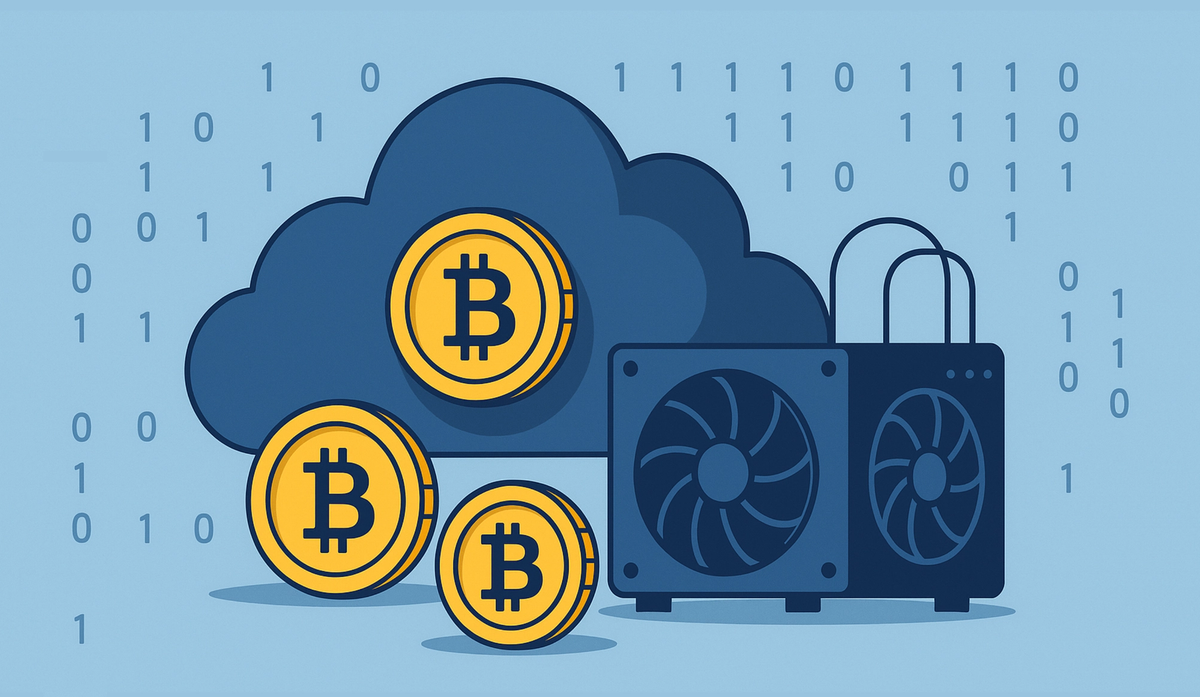
Cryptocurrency mining has become increasingly difficult for individual users as specialized hardware, electricity costs, cooling requirements, and competition between large mining companies have increased. Bitcoin mining, in particular, is now dominated by industrial operations running large numbers of ASIC machines in locations where power and infrastructure costs are lower.
Cloud mining developed as a way for users to participate without building their own mining operation. Customers pay a provider to operate mining equipment on their behalf and receive part of the resulting cryptocurrency. The model removes much of the technical work, but it also exposes customers to changing mining economics, contract fees, provider failure, and fraud.
What Is Cloud Mining?
Cloud mining is a service through which a customer rents cryptocurrency mining capacity from a third-party operator. The provider owns or manages the mining equipment, supplies electricity and cooling, connects the machines to a mining pool, and handles maintenance. Customers usually purchase a stated amount of hash rate for a fixed period and receive a share of the mining revenue after electricity, maintenance, pool, and service fees are deducted.
In most cloud mining arrangements, the customer does not own or control a specific mining machine. Instead, the customer holds a contract linked to the output of the provider’s mining operation. Returns therefore depend on the rented hash rate, equipment uptime, network difficulty, block rewards, transaction fees, cryptocurrency prices, operating charges, and whether the provider accurately reports production and processes withdrawals.
Cloud Mining vs. Cloud Computing
Despite the name, cloud mining is different from traditional cloud computing services such as Amazon Web Services (AWS), Microsoft Azure, or Google Cloud. In cloud computing, users rent computing resources like servers, storage, or processing power to run applications or manage data. Cloud mining, by contrast, gives users access to cryptocurrency mining capacity operated by a third-party provider.
Instead of running software on virtual servers, customers pay for a specified amount of hash rate generated by specialized mining hardware, usually ASIC miners. Instead of running software on virtual servers, customers rent hash rate generated by specialized mining hardware operated by a third-party provider. The rented computing power can be used only for cryptocurrency mining rather than general-purpose computing.
How a Cloud-Mining Contract Works
A cloud-mining contract allows a customer to rent cryptocurrency mining capacity from a provider for a specified period or under predefined terms. Although contract structures vary between platforms, the process generally follows these steps:
- Choose a Mining Plan: The customer selects a cryptocurrency, a hash rate (such as TH/s for Bitcoin), and a contract duration. The provider specifies the upfront cost, recurring fees, payout schedule, and other terms.
- The Provider Allocates Mining Capacity: Once the contract is activated, the provider assigns the purchased hash rate to its mining operation. Once the contract is activated, the provider allocates the purchased hash rate to its mining operation and manages the underlying mining infrastructure throughout the contract.
- Mining Begins: The rented hash rate contributes to validating blockchain transactions and competing to mine new blocks. When the mining pool earns block rewards and transaction fees, the customer's share is calculated based on the amount of hash rate rented and the contract's payout method.
- Fees Are Deducted: Before payouts are distributed, the provider deducts any applicable charges, which may include electricity, maintenance, pool, or service fees. Some contracts include these costs in the purchase price, while others charge them separately.
- Rewards Are Paid: The remaining cryptocurrency is credited to the customer's account or wallet according to the provider's payout schedule, which may be daily, weekly, or based on a minimum withdrawal threshold.
Throughout the contract, actual returns can increase or decrease as cryptocurrency prices, network difficulty, mining competition, transaction-fee revenue, and operating costs change. Most contracts also include conditions covering early termination, downtime, or situations where mining revenue no longer exceeds operating costs, making it important to review the terms before purchasing.
What Determines Cloud Mining Profitability?
Cloud mining returns are not fixed and can change throughout the contract. A contract is profitable only when the value of the cryptocurrency received exceeds the upfront price and all related fees.
- Cryptocurrency Price: The market price of the mined cryptocurrency determines the value of mining rewards. Rising prices can increase the value of payouts, while falling prices can reduce or eliminate profits.
- Network Difficulty: Higher mining difficulty means the same amount of hash rate is expected to earn fewer coins. Difficulty can rise or fall as the network’s total computing power changes.
- Block Rewards and Transaction Fees: Mining revenue comes from block subsidies and transaction fees. Changes in either can increase or reduce the amount earned by a given hash rate.
- Hash Rate and Contract Price: More rented hash rate generally produces more mining output, but it also costs more. Profitability depends on whether the revenue generated exceeds the price paid for the contract.
- Contract Fees: Electricity, maintenance, pool, service, withdrawal, and other charges reduce net returns. These costs may be included in the purchase price, charged separately, or deducted from payouts.
- Contract Duration: Longer contracts may generate more cryptocurrency, but they are also exposed to future changes in difficulty, mining rewards, fees, and market prices.
- Equipment Performance and Uptime: Hardware failures, maintenance, curtailment, or connection problems can reduce mining output. Contract terms should explain how downtime is handled.
- Pool and Termination Terms: Pool fees, payout methods, minimum withdrawal thresholds, and early termination rules can affect both the amount received and whether the contract remains active during unprofitable periods.
Because these factors change over time, cloud mining contracts cannot guarantee profits. Before purchasing one, customers should compare the expected net return with the full contract cost and with the amount of cryptocurrency they could buy directly for the same money.
Benefits of Cloud Mining
Cloud mining makes cryptocurrency mining more accessible by removing many of the costs and technical requirements associated with operating mining hardware. Its main benefits include:
- No Hardware Purchase: Customers can participate in cryptocurrency mining without buying expensive ASIC miners or other specialized equipment.
- No Equipment Maintenance: The provider is responsible for installing, operating, repairing, and updating the mining hardware.
- No Electricity, Cooling, or Noise Management: Customers do not need to supply electricity, install cooling systems, or deal with the heat and noise generated by mining equipment at home.
- Access From Anywhere: Because the mining equipment is operated remotely, customers can monitor their contracts and receive payouts without hosting mining hardware at home.
- Lower Technical Barrier: Cloud mining eliminates much of the technical knowledge required to configure hardware, install mining software, connect to mining pools, and monitor equipment.
- Access to Industrial Mining Infrastructure: Providers typically operate large mining facilities designed for continuous operation, giving customers access to professional infrastructure that would be costly for most individuals to build.
- Flexible Participation: Most providers offer contracts with different hash rates and durations, allowing customers to start with smaller investments or increase their mining capacity over time.
Risks of Cloud Mining
Although cloud mining removes many of the technical challenges of operating mining hardware, it also introduces risks that can affect both mining returns and the customer's investment.
- Fraud and Scam Platforms: Cloud mining has been associated with numerous fraudulent schemes in which operators falsely claim to own mining facilities or promise guaranteed returns. Before purchasing a contract, customers should verify the provider's reputation, business history, and mining operations.
- Limited Control and Counterparty Risk: Unlike traditional mining, customers usually do not own or manage the mining hardware. They must rely on the provider to operate the equipment, accurately report mining output, and distribute rewards according to the contract.
- Changing Mining Profitability: Mining revenue can decline as network difficulty increases, transaction-fee revenue changes, or cryptocurrency prices fall. A contract that appears profitable when purchased may generate significantly lower returns over time.
- Contract Fees: Electricity, maintenance, pool, service, and withdrawal fees can reduce mining returns. Because fee structures vary between providers, customers should review all charges before purchasing a contract.
- Contract Suspension or Early Termination: Some providers reserve the right to suspend mining or terminate contracts if mining revenue no longer covers electricity or operating costs. Customers should understand these conditions before entering an agreement.
- Provider Failure: Cloud mining customers depend on the provider's financial stability and operational reliability. If a company experiences technical problems, becomes insolvent, or ceases operations, customers may lose access to future mining rewards, any remaining contract value, or pending withdrawals.
- Regulatory Changes: Cryptocurrency mining and cloud mining services are subject to different laws and regulations depending on the jurisdiction. Changes to regulations may affect a provider's operations, contract availability, or a customer's ability to use the service legally.
Cloud Mining vs. Traditional Mining
Both cloud mining and traditional mining allow users to earn cryptocurrency through blockchain mining, but they differ significantly in ownership, responsibility, costs, and risk. Cloud mining outsources the mining operation to a third-party provider, while traditional mining requires users to purchase, operate, and maintain their own equipment.
| Feature | Cloud Mining | Traditional Mining |
|---|---|---|
| Hardware Ownership | The provider owns and operates the mining equipment. | The miner owns and controls the hardware. |
| Setup | No hardware installation or technical configuration is required. | Requires purchasing, installing, and configuring mining equipment. |
| Maintenance | The provider manages repairs, upgrades, and maintenance. | The owner is responsible for maintaining and replacing hardware. |
| Electricity and Cooling | Managed by the provider, with costs typically included in or charged through the contract. | Paid and managed directly by the miner. |
| Control | Limited control over the mining operation and equipment. | Full control over hardware, mining software, mining pools, and operating settings. |
| Upfront Cost | Usually lower than purchasing mining hardware, depending on the contract. | Typically requires a significant investment in mining equipment and infrastructure. |
| Scalability | Mining capacity can usually be increased by purchasing additional hash rate. | Expanding requires buying and operating additional hardware. |
| Risks | Primarily contract, provider, and counterparty risks. | Primarily equipment, electricity, operational, and hardware depreciation risks. |
How to Choose a Cloud Mining Provider
Choosing a reputable cloud mining provider is one of the most important factors in reducing risk. Before purchasing a contract, consider the following:
- Company Reputation: Research the provider's operating history, customer reviews, and any past regulatory actions, lawsuits, or security incidents. Be cautious of newly established companies with little publicly available information.
- Transparent Contract Terms: Review the contract carefully, including its duration, pricing, payout schedule, electricity and maintenance fees, minimum withdrawal amount, refund policy, and any conditions allowing the provider to suspend or terminate the agreement.
- Verified Mining Operations: Reputable providers should clearly explain how their mining operations work and provide information about their mining facilities, hardware, or mining capacity. Be cautious of companies that make unverifiable claims or provide little information about their operations.
- Fee Structure: Compare all costs, not just the upfront price. Electricity, maintenance, pool, withdrawal, and other service fees can significantly reduce mining returns.
- Security Measures: Choose providers that offer strong account security, such as two-factor authentication (2FA), secure withdrawal procedures, and account verification features.
- Customer Support: Reliable providers should offer responsive customer support and clear communication channels for technical issues, payments, and account-related questions.
- Reputation and Customer Feedback: Research independent reviews, community discussions, and any history of regulatory actions, lawsuits, or security incidents. Consistent complaints about withdrawals, hidden fees, or customer support should be treated as warning signs.
- Unrealistic Promises: Avoid providers that advertise guaranteed profits, fixed daily returns, or unusually high mining rewards. Cryptocurrency mining returns depend on changing market conditions and cannot be guaranteed.
Is Cloud Mining Worth It?
Whether cloud mining is worth it depends on a customer's goals, the terms of the contract, and the provider's reliability. Cloud mining offers a convenient way to participate in cryptocurrency mining without purchasing or managing hardware, making it an attractive option for users who want mining exposure without the technical and operational responsibilities.
However, cloud mining is not a guaranteed source of profit. Returns can change throughout the contract as cryptocurrency prices, network difficulty, mining rewards, and operating costs fluctuate, while contract fees and provider performance can further reduce earnings. Customers also assume counterparty risk because they depend on the provider to operate the mining equipment, accurately report mining output, and process withdrawals.
Before purchasing a contract, compare its expected net return with the total contract cost and with the amount of cryptocurrency you could buy directly for the same investment. A cloud-mining contract may be worth considering only if the provider is transparent, the fees are clearly disclosed, and the projected returns justify the additional risks compared with other ways of gaining exposure to cryptocurrency.
Frequently Asked Questions (FAQs)
Yes, cloud mining is a legitimate way to participate in cryptocurrency mining without owning mining hardware. However, the industry has also been associated with fraudulent schemes and unreliable operators. Before purchasing a contract, research the provider's reputation, verify its mining operations, and review the contract terms carefully.
Cloud mining can be profitable, but returns are not guaranteed. Profitability depends on factors such as cryptocurrency prices, network difficulty, block rewards, transaction fees, contract costs, and the provider's operating fees. A contract that is profitable today may generate lower returns if market conditions change.
Yes. Customers can lose money if mining revenue declines, fees exceed earnings, the provider suspends or terminates the contract, or the company experiences financial or operational problems. Cloud mining should be viewed as a financial commitment with both market and counterparty risks.
Neither option is inherently better, they serve different purposes. Buying cryptocurrency provides direct ownership and immediate exposure to market price movements, while cloud mining allows users to earn cryptocurrency through mining without operating hardware. The better choice depends on an individual's investment goals, risk tolerance, and preference for owning cryptocurrency versus participating in mining.
Look for providers with a transparent business, clearly defined contract terms, a verifiable operating history, and strong customer feedback. Be cautious of companies that promise guaranteed profits, advertise fixed daily returns, or provide little information about their mining operations, fees, or withdrawal policies.