DMCA takedowns have been a hot topic in recent years, especially their use as an unethical SEO tactic to remove competitors’ pages or suppress reporting critical of companies in Google Search. During 2026, several high-profile takedowns drew renewed public attention, fueling complaints from business owners, publishers, and SEO experts.
In March 2026, Press Gazette’s Rob Waugh published an investigation into Clickout Media’s alleged exploitation of acquired news websites by replacing human writers with AI-generated content and filling pages with gambling links. The investigation caught the industry’s attention and became the target of a bogus DMCA complaint that caused it to disappear from Google Search. Search Engine Land’s article covering the investigation was also removed following a false complaint, adding fuel to an already heated discussion. Both articles were back in Google Search by March 31.
In June, another investigation by Waugh in Press Gazette examined AI-generated reporters publishing stories containing errors and fabrications on sports news websites acquired by Clickout Media. That article was also removed from Google Search following a copyright complaint from an unidentified party, prompting another public complaint from the publication.
These incidents became part of a broader discussion about the SEO risks posed by fraudulent takedowns. Across articles and social media discussions, a recurring theme was Google’s contribution to their success. Some criticized Google for accepting complaints without adequate checks. Others pointed to the legal structure and incentives of the notice-and-takedown framework, which can leave publishers disputing allegations after their pages have already disappeared. Google, for its part, says it rejects requests it identifies as improper or unsupported.
Why URL Capitalization Caught Our Attention
One aspect of these successful takedowns flew under the radar in the recent discussions. The complaints often listed URLs with different capitalization from the URLs actually removed from Google Search. We observed this in complaints targeting the two Press Gazette articles and the Search Engine Land article.


We had also noticed this in a complaint targeting one of our own articles, which was removed from Google Search last year. The article examined possible ownership and personnel ties between Finixio, Clickout Media, Block Labs, Tech Alchemy, Best Wallet, Tamadoge, and Battle Infinity.

URL paths are case-sensitive. Google’s documentation, for example, says it treats /APPLE and /apple as distinct URLs. So how could it be that a page with an all-lowercase URL is being taken down when the allegedly infringing URL is reported with capitalized letters?
At that point, our minds were set on testing the DMCA process. As part of our journalistic investigation, we tested the copyright complaint process using our own pages to see how Google would handle the submissions. Yes, we complained about our own articles or project pages and used invented names and company names in the complaints to mimic the tactics used by bad actors. We weren’t entirely comfortable with that, but we wanted firsthand evidence of how these takedowns happen.
We didn’t think it would be sensible to submit a large number of complaints. So we focused on a few targeted tests using different pages and URL combinations. We hoped these tests would give us a better sense of how Google handles copyright complaints, how false claims can get through, and whether URL capitalization plays a role.
Our Initial Complaints Prompted Requests for More Information
The DMCA complaint form is straightforward to fill out. It asks for some information such as a first and last name, an optional company name, the copyright holder you represent, and a country or region. It uses the email address of your signed-in Google account.
You must also describe the copyrighted work and provide URLs for an authorized example and the allegedly infringing material. Finally, you must check boxes confirming ownership or authority to act, good faith, accuracy under penalty of perjury, and that you acknowledge the notice may be shared with Lumen. You don’t have to upload identity documents to complete the form.
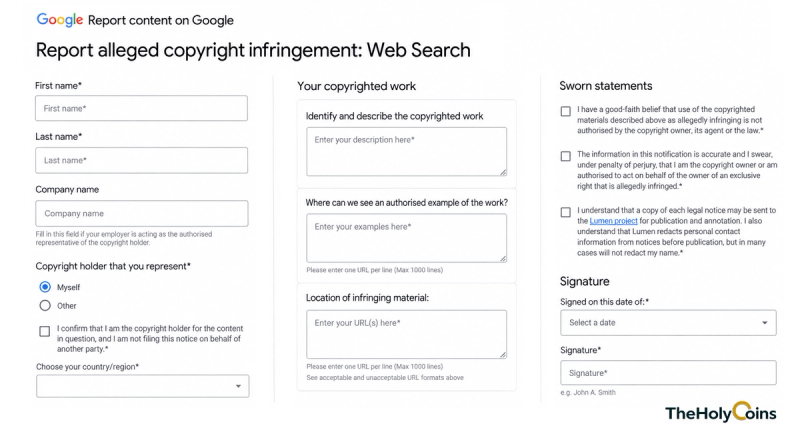
We decided to start with a simple scenario. We listed a published TheHolyCoins page as the allegedly infringing URL and a page on another website as the original work.
A few hours after we submitted the complaint, Google emailed us asking us to “please identify the exact content that you claim infringes your copyright.” Since we thought this might indicate human review (although we couldn’t confirm it), we decided not to pursue that submission further. We felt that a reviewer was unlikely to approve it, didn’t want to waste a real person’s time, and were concerned our Google account might be flagged.

We tried several variations of this test using other URLs. Each time, Google requested more information about the alleged infringement rather than approving the takedown.
Three of Four Two-URL Complaints Resulted in Takedowns
Then we moved to testing capitalization. The DMCA form allows you to include more than one allegedly infringing URL in a complaint. We used that feature and made several attempts involving different pages on our platform, changing one to four letters in each URL to uppercase so that the submitted address differed from the published lowercase URL.
In some DMCA requests, we submitted only a mixed-case URL, and in others we listed two allegedly infringing URLs: the original all-lowercase URL and a mixed-case version.
When submitting only a mixed-case URL, we wanted to see whether Google would mistakenly remove the published lowercase version, even though the complaint did not include that exact URL. For these requests, we received the response: “We were unable to locate the content in question.” Below is an example.

However, we found that getting our pages removed was easier than we had expected. To our surprise, three out of four fake DMCA complaints containing both versions of the URL resulted in a page temporarily disappearing from Google Search.
In these cases, less than two hours after submission, our admin email address received a “Google notice regarding copyright-related content” indicating that one of our pages was being removed from Google Search.
It took about another day for the targeted page to actually disappear from Google’s search results and for the familiar message stating that results had been removed in response to DMCA complaints to appear at the bottom of the first page of search results.
Below is an example of the notification we received from Google in one of these cases.

More URL Variants Produced Different Results
We decided to continue with the same approach, including the correct, all-lowercase URL alongside mixed-case versions of the same page address. But this time, we had five to twelve URLs in each request.
Again, we succeeded in getting pages removed from Google Search. However, the success rate was lower, with only two of six requests resulting in actual takedowns.

Google also appeared to us to respond inconsistently to similar URL combinations. In one request, we included four mixed-case URLs and one valid all-lowercase URL. The result was that all five were marked “Pending review,” with Google asking us to identify the exact content we claimed infringed our copyright for each URL. In other cases, only the all-lowercase URL remained pending review, while the mixed-case URLs were rejected.
Google Reported Removing a Page That Never Existed
While these takedowns showed it’s possible to remove legitimate pages from Google’s search results, they also left us suspecting that the main problem was bugs in Google’s processing system, rather than Google simply having an itchy trigger finger.
In one case, we submitted a DMCA request with five URLs. As before, one was valid and fully lowercase, and the rest had different letters capitalized. In one of those variants, we accidentally made a spelling mistake while changing the capitalization. Less than an hour later, the report dashboard showed one approved URL, three rejected URLs, and one URL with a “Not in index” status.
The outcome was stranger than before. Our admin email received a message stating that two URLs had been removed from Google’s search results. One was the valid, all-lowercase URL. The second was the misspelled one, which had never existed on our site in any capitalization variant.
The following day, the message at the bottom of Google’s search results also said that two results had been removed, even though only one actual page was taken down. Google reported the removal of a nonexistent page, an apparent error in its removal reporting, in our opinion.


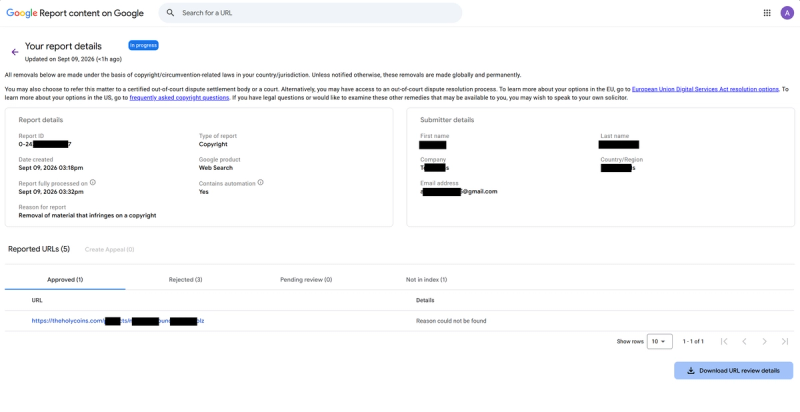
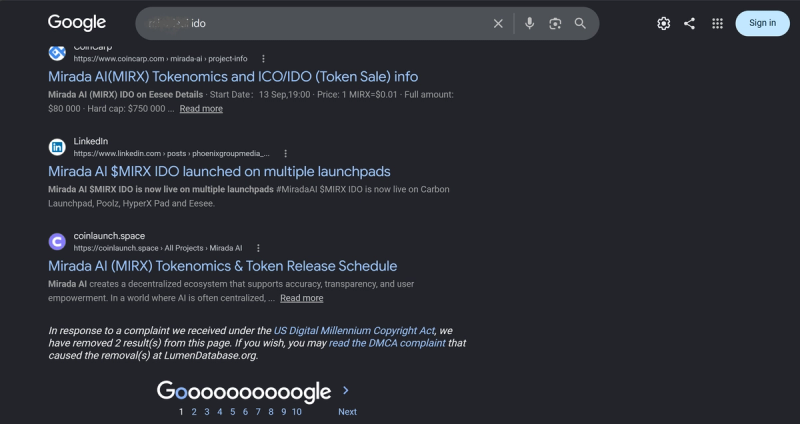
Google says it also processes complaints against URLs outside its index, but that does not explain why its messages described this nonexistent URL as a removed result.
In total, the false complaints submitted during the tests caused Google to remove five legitimate pages from the search results.
Google had faced a problem with URL capitalization before. In July 2025, Freedom of the Press Foundation reported that changing letters in an article’s URL to uppercase could get the live article removed from Google Search through its Refresh Outdated Content tool. In response to the foundation’s questions, Google said it had rolled out a fix to prevent this abuse, but declined to explain how it worked.
That was a different tool, and we don’t know whether the problems are related, but it shows that URL handling had gone wrong in Google’s removal systems before.
Google Reversed the Takedowns Without Further Notice
But in all these cases where a page was taken down, one more thing happened. About a day after we spotted the removal, the page returned to Google’s search results without any additional notice.
Google had reversed the takedowns, and we cannot determine why. A self-healing process or a subsequent manual review might explain it, but we don’t have enough information to say which, if either, occurred.
We also cannot say whether the mechanism behind the reversal is new, whether it has been in place for some time, or whether it had any connection to the recent scrutiny of Google’s takedown process.
Our tests left us questioning whether Google accepting copyright complaints too readily could alone explain these outcomes. The initial false complaints prompted requests for more information and were later closed after we did not respond. Yet some of the later submissions led to temporary takedowns, and Google even reported removing a page that had never existed. Taken together, these results strengthened our suspicion that bugs in the system may contribute to wrongful removals.
The return of the pages was welcome, but it did not erase the fact that the false complaints submitted during the tests had successfully taken them out of search. For publishers whose reporting or business depends on being found, even a temporary removal can matter. We hope Google can explain what it is doing to prevent these errors and whether the publishers affected can expect their pages to return as quickly as ours did.
About This Investigation
We conducted these limited tests to investigate how false copyright complaints can affect publishers’ visibility in Google Search. Every URL we submitted for removal was on our own website; we did not request the removal of another publisher’s pages. We used invented complainant details and cited third-party works as purported originals as part of the tests, without asserting any actual ownership of those works in this article.
Our findings describe the submissions, responses, and search outcomes we observed. References to possible bugs are our interpretation of those observations; we do not have access to Google’s internal decision-making systems. We are publishing this account to inform discussion about safeguards against wrongful removals, not to encourage fraudulent complaints.