Every crypto app runs on data it does not own. Prices come from one feed. Wallet balances come from another. Swaps settle through a third. A developer picks those APIs, and the users live with the result.
The stakes grew in 2026. In July, DEX spot volume hit a record 24% of CEX volume (The Block). More trading now happens onchain, where every click is an API call. Every presale tracker, wallet, and exchange page you open is API output.
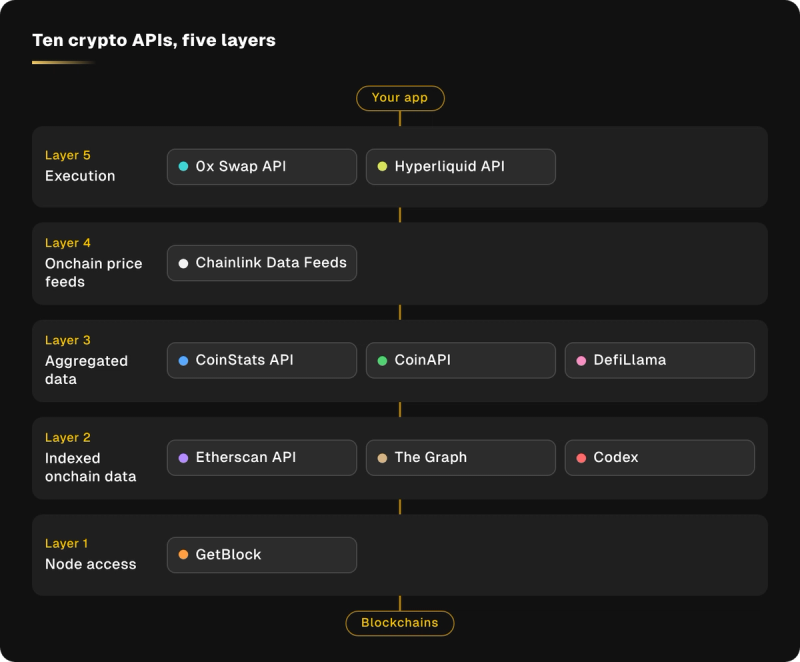
This guide compares ten crypto APIs for developers. Each one owns a different layer, from raw nodes to trade execution. The figures were checked in October 2026 against official docs and pricing pages. New to the vocabulary? Start with the TheHolyCoins guide to crypto presales.
How These Ten Crypto APIs Were Picked
An API earns a place here by owning one layer well. The ten are not substitutes for each other. Most production apps end up using two or three.
- One layer each: Nodes, indexed on-chain data, aggregated data, on-chain price feeds, and execution. Every pick covers a different job.
- A low bar to entry: All ten can be tried without a sales call. Codex asks a one-time $1.
- Published prices: Each entry lists the first paid step in dollars, percent, or gas.
- AI readiness: Five of the ten ship an MCP server that returns live data. DefiLlama sells one with its API plan. Three more ship docs-focused MCP servers.
- Real usage: The Graph reports 1.27 trillion queries served. 0x reports $200 billion settled in swaps.
Crypto API Comparison at a Glance
The matrix below scores each API on eight jobs. A full dot means the job is a core product. A half dot means partial coverage or an add-on.

The same facts in plain text, for each API: layer, best fit, free tier, and first paid step.
- CoinStats API: Aggregated data. Market, wallet, DeFi, and portfolio data from one key. Free tier: 20,000 credits a month. First paid step: Starter, $49 a month.
- GetBlock: Node access. Node RPC across 127 chains. Free tier: 50,000 compute units a day. First paid step: Starter, $49 a month.
- CoinAPI: Aggregated data. Exchange-grade market data and history. Free tier: $25 in credits. First paid step: $79 a month.
- Codex: Indexed on-chain data. Real-time DEX token and prediction-market data. Free tier: 10,000 requests a month, $1 one-time. First paid step: Growth, $350 a month.
- Etherscan API: Indexed on-chain data. Contracts, balances, and history on 60+ EVM chains. Free tier: 100,000 calls a day. First paid step: Lite, $49 a month.
- The Graph: Indexed on-chain data. Custom indexing of your own contracts. Free tier: 100,000 queries a month. First paid step: $2 per 100,000 queries.
- DefiLlama: Aggregated data. DeFi TVL, yields, fees, and stablecoins. Free tier: Open API, no key. First paid step: API plan, $300 a month.
- Chainlink Data Feeds: On-chain price feeds. Prices a smart contract can trust. Free tier: On-chain reads, gas only. First paid step: Data Streams, on request.
- Hyperliquid API: Execution. Perps and spot trading on Hyperliquid. Free tier: Full API, no key for reads. First paid step: Trading fees from 0.015%.
- 0x Swap API: Execution. Swap routing inside wallets and dApps. Free tier: Free account. First paid step: 0.15% fee on select pairs.
What the Free Tiers Actually Cover
"Free" means ten different things across these APIs. Some count credits, some count compute units, some count calls a day. Two need no key at all.
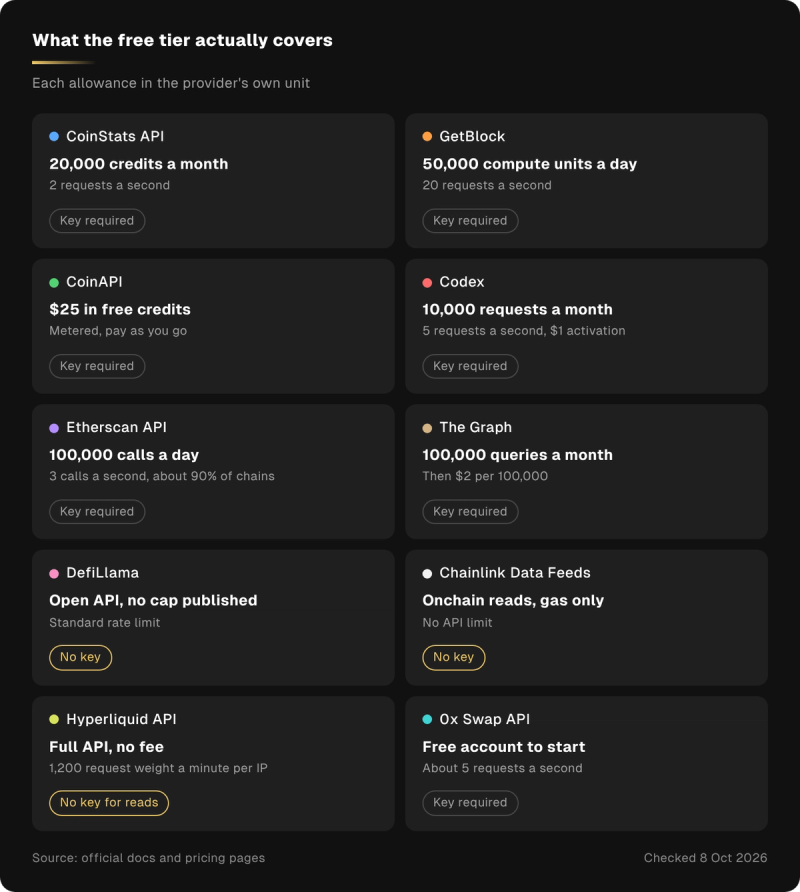
Three patterns help. Daily caps at GetBlock and Etherscan API suit steady polling. Monthly caps at CoinStats API, Codex, and The Graph suit bursts around launches. Keyless access at DefiLlama, Chainlink, and Hyperliquid suits prototypes that ship in a weekend.
The honest test is a week of real traffic. Count your calls per user, then multiply by expected users. That number tells you which tier you really need.
What You Pay After the Free Tier
Entry plans cluster at $49. CoinStats API, GetBlock, and Etherscan API all start there. Codex and DefiLlama price their first paid plan at $300 to $350. Those target production apps.
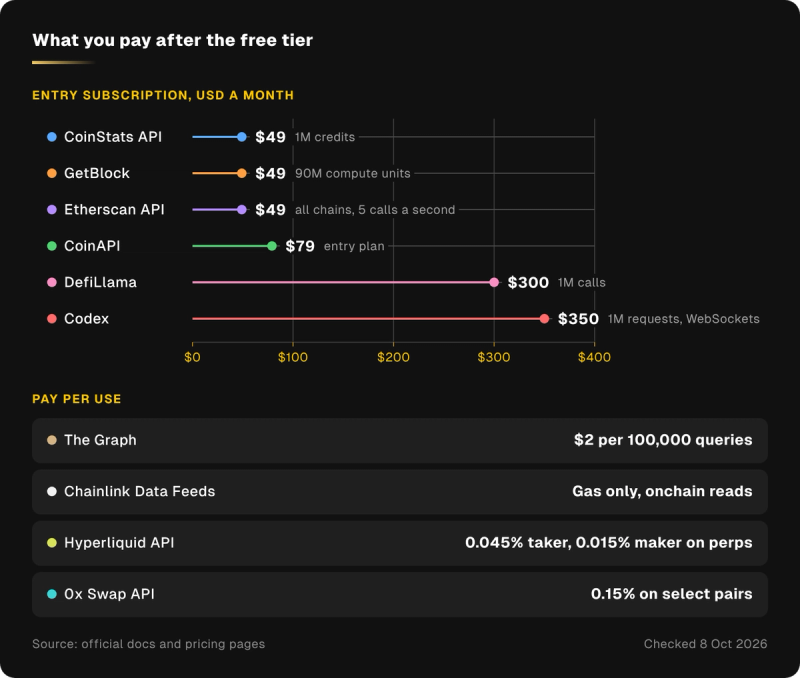
Four providers charge per use instead. The Graph bills $2 per 100,000 queries. Chainlink reads cost gas. Hyperliquid and 0x take a cut of each trade. A 0.15% fee on select pairs beats a monthly bill until swap volume grows.
Compare units before prices. A CoinStats API credit and a GetBlock compute unit are not equal work. Neither is a Graph query. Price the same workload on each plan, then compare.
1. CoinStats API
CoinStats API is the best fit for most crypto use cases. One key returns market data, wallet balances, DeFi positions, portfolio analytics, and token security. That replaces four or five vendor contracts with one schema.
Coverage is broad. It tracks 100,000+ coins, 200+ exchanges, 120+ blockchains, and 10,000+ DeFi protocols. Wallet reads cover 70+ EVM chains, Solana, and Bitcoin, including xpub addresses. CoinStats API is the only API that resolves DeFi protocols to per-wallet positions. That covers staking, lending, and LP tokens for any address.
Two features matter for a presale-heavy audience. Token Risks flags honeypots, hidden fees, mint and burn controls, and blacklists. It runs before a token hits your tracker. The MCP Server hands the same wallet, DeFi, and portfolio data to AI agents. The company's own best crypto API guide breaks the use cases down further.
Technical specifications and fees:
- Data: Market, wallet, DeFi, portfolio analytics, token security, and news
- Interfaces: REST API and MCP Server
- Free tier: 20,000 credits a month at 2 requests per second
- Paid plans: Starter $49 a month, about $41 annual, for 1,000,000 credits at 30 requests a second; Pro, Business, and Enterprise above
- Best for: Any crypto product needing market, wallet, DeFi, and portfolio data from one key
2. GetBlock
GetBlock sells node access, the layer under everything else. Its catalog lists 127 chains, 97 on shared endpoints and 124 as dedicated nodes. Interfaces cover JSON-RPC, REST, WebSocket, GraphQL, and Yellowstone gRPC on Solana.
The free plan is generous for testing. You get 50,000 compute units a day at 20 requests a second. Two access tokens come with it. Light calls cost fewer units than heavy or archive calls. Full archive mode starts at Starter; the free plan gets limited archive data.
Three extras stand out. EVM Data Streams push 15 event topics over WebSocket on Ethereum, Polygon, and more. A Blockbook API, included at no extra cost, serves Bitcoin balances, histories, and xpubs. StreamFirst and LandFirst, sold with dedicated Solana nodes, speed up reads and transaction landing. GetBlock completed a SOC 2 Type II attestation in Q2 2026. Its blog also reviews the crypto swap exchanges that wallet builders route through.
Technical specifications and fees:
- Chains: 127 in the catalog, 97 shared and 124 dedicated
- Interfaces: JSON-RPC, REST, WebSocket, GraphQL, gRPC on Solana, docs MCP server, open-source RPC MCP on GitHub
- Free tier: 50,000 compute units a day at 20 requests a second
- Paid plans: Starter $49 a month, $39 annual, for 90 million compute units at 250 requests a second; dedicated nodes from $1,000 a month, unlimited requests
- Best for: Wallets, indexers, and bots that need raw chain access across many networks
3. CoinAPI
CoinAPI is the exchange-data specialist on this list. It normalizes market data from 400+ exchanges into one format. That covers 18,000+ assets and 916,000+ symbols, including DEX pairs and tokenized stocks.
Depth is the selling point. History goes back 10+ years, down to tick-by-tick trades and full order books. Spot, futures, perpetuals, and options are all covered. A current major focus is Hyperliquid L4 data, enabling order-level book reconstruction and detailed market microstructure analysis. Delivery runs over REST, WebSocket, FIX, flat files, and an MCP server.
A separate EMS Trading API manages orders and positions across exchanges through one integration. For a quant desk, that pairs the data side with execution. For a price ticker, the Market Data API alone is enough.
CoinAPI's sister, FinFeedAPI, covers prediction markets. Its Prediction Markets API tracks 9 venues, including Polymarket and Kalshi. Prediction market data is a growing focus for both brands.
Technical specifications and fees:
- Coverage: 400+ exchanges, 18,000+ assets, 916,000+ symbols, 10+ years of history; prediction markets across 9 venues via FinFeedAPI
- Interfaces: REST, WebSocket, FIX, flat files, MCP server
- Free tier: Metered plan with $25 in free credits
- Paid plans: Startup $79, Streamer $249, and Pro $599 a month, Enterprise custom; FIX included on Pro or $99 a month extra
- Best for: Backtesting, quant research, and any product that needs exchange-level market data
4. Codex
Codex is an enriched blockchain data API built on two pillars: tokens and prediction markets. The token side delivers real-time prices, OHLCV charts, holder analytics, and wallet balances. Coverage spans 105M+ tokens, 2B+ wallets, and 80+ networks. Data freshness is under 1 second across EVM, Solana, and more.
The prediction-market side is the second pillar. One schema returns odds, volume, trending events, price history, and trader analytics. It spans Polymarket and Kalshi. Everything arrives enriched: USD prices, OHLCV candles, holder analytics, aggregated volume, and token metadata.
Developers get a GraphQL API, WebSocket subscriptions with 99.9% uptime, and webhooks. AI agents get a TypeScript SDK, an MCP server, skills, and pay-per-request via MPP. Codex powers TradingView, Uniswap, MoonPay, and Pump.fun. It is not a Bitcoin API, an execution API, or a DeFi-position decoder. For those jobs, pair it with a portfolio layer like the CoinStats API.
Technical specifications and fees:
- Coverage: 105M+ tokens, 2B+ wallets, 80+ networks, plus Polymarket and Kalshi
- Interfaces: GraphQL API, WebSocket subscriptions, webhooks, TypeScript SDK (@codex-data/sdk), MCP server, MPP payments
- Free tier: "Almost free" tier: 10,000 requests a month after a one-time $1 activation; token pricing, pair stats, search, and trending endpoints only; no WebSockets
- Paid plans: Growth from $350 a month for 1 million requests with full endpoint access, WebSockets, and webhooks
- Best for: DEX terminals, trading bots, and AI agents needing real-time token and prediction-market data
5. Etherscan API
Etherscan API turns the explorer every EVM user knows into a data source. API V2 uses one key across 60+ EVM chains. It returns balances, token transfers, transaction history, logs, and gas estimates.
Contract data is the differentiator. Verified source code and ABI endpoints stay free on every tier. That makes it the quickest way to check what a presale contract actually does.
The free tier changed in November 2025. BNB Chain, Base, OP Mainnet, Avalanche, and Gnosis now need a paid plan. Etherscan says the free tier keeps about 90% of chain coverage. Etherscan added an official MCP server in August 2026. It ships 21 read-only tools, plus a keyless version with 16. A CLI and agent skills launched alongside it.
Technical specifications and fees:
- Chains: 60+ EVM networks on one key, with 33 mainnets and 30 testnets listed
- Interfaces: REST, official MCP server (keyed and keyless), CLI, agent skills
- Free tier: 3 calls a second, 100,000 calls a day, about 90% of chains
- Paid plans: Lite $49 a month, about $42 annually, for 5 calls a second on all chains; Standard $199 a month, 10 calls a second, 200,000 calls a day
- Best for: Address history, contract verification, and explorer features inside your own app
6. The Graph
The Graph indexes blockchain data through subgraphs you define yourself. You describe the events and entities. Indexers do the work, and your app queries GraphQL. The network reports 1.27 trillion+ queries served for 75,000+ projects.
Pricing is simple. Subgraph Studio gives 100,000 free queries a month, then $2 per 100,000. You can pay by card or in GRT. Coverage spans 60+ networks, and Substreams extend indexing to Solana and other non-EVM chains.
Two 2026 details matter. The Token API now lives with Pinax, and thegraph.com redirects there. An open-source Subgraph MCP lets AI tools find subgraphs, read schemas, and run queries.
Technical specifications and fees:
- Coverage: 60+ networks for subgraphs; Substreams for Solana, Injective, Starknet, and more
- Interfaces: GraphQL, Substreams, Subgraph MCP
- Free tier: 100,000 queries a month
- Paid plans: $2 per 100,000 queries beyond the free tier, billed monthly
- Best for: Protocols and dApps that need custom indexing of their own contracts
7. DefiLlama
DefiLlama runs the open DeFi dataset most dashboards quote. The free API needs no key. It covers TVL, prices, stablecoins, and yields. It also tracks DEX and options volumes, perps open interest, fees, and revenue.
Scale is the draw. The site tracks 8,818 protocols across 559 chains. DeFi TVL stood at $93.5 billion on 8 October 2026, per DefiLlama. Stablecoin supply sat at $307 billion. It is also the fastest way to check a "partner protocol" for real deposits. Protocol pages show market cap and fully diluted valuation in one panel. The TheHolyCoins FDV vs market cap guide explains the gap between the two.
The paid API plan adds 38 endpoints. Those cover token unlocks, bridges, ETFs, and real-world assets. An official MCP server with 23 tools comes with that plan. CoinStats' own guide to the best DeFi APIs ranks DefiLlama among its top picks.
Technical specifications and fees:
- Coverage: 8,818 protocols and 559 chains
- Interfaces: REST, with no key for the open API; hosted MCP server on the API plan
- Free tier: Open endpoints with no key and no published cap
- Paid plans: API plan $300 a month or $3,000 a year: 1 million calls, 1,000 requests a minute; overage $0.60 per 1,000 calls
- Best for: DeFi dashboards, yield trackers, and research tools
8. Chainlink Data Feeds
Chainlink Data Feeds publish prices a smart contract can read. Independent node operators update on-chain aggregator contracts. Your contract reads the latest answer with a view call. A read costs only the gas of the transaction it sits in.
Feed types go beyond prices. They include Proof of Reserve, NAV, rates, L2 sequencer uptime, and tokenized equities. Chainlink reports $36.4 trillion in transaction value enabled as of 6 October 2026. DefiLlama puts its total value secured at $37.5 billion.
Data Streams add speed. They deliver sub-second signed reports that contracts verify on-chain, priced by subscription on request. Chainlink for Agents launched in beta in August 2026. It adds agent skills and x402 pay-per-use in USDC. If your contract settles on a rollup, read the TheHolyCoins Layer-2 guide first.
Technical specifications and fees:
- Coverage: Price, Proof of Reserve, NAV, rates, L2 sequencer uptime, and tokenized equity feeds
- Interfaces: Onchain aggregator contracts, Data Streams (pull-based), Chainlink for Agents, early-access docs MCP
- Free tier: Onchain reads cost gas only
- Paid plans: Data Streams by subscription, pricing on request
- Best for: Lending, perps, and stablecoin contracts that settle on prices
9. Hyperliquid API
Hyperliquid API opens the venue behind about a third of onchain perps volume. DefiLlama's 30-day perps figures to 8 October 2026 put its share at 32.8%. Cumulative perp volume stands at $5.46 trillion, with $8.7 billion in open interest.
Reads and writes are split. The info endpoint returns order books, trades, candles, funding, open interest, and account state. The exchange endpoint accepts signed actions: orders, cancels, modifies, and TWAPs. A WebSocket stream covers both.
Limits are public and strict. REST allows 1,200 request weight per minute per IP. Per address, trades earn 1 request per 1 USDC traded after a 10,000-request buffer. Fees start at 0.045% taker and 0.015% maker on perps. HIP-3 went live in October 2025 and lets builders deploy their own perps markets. Those markets did $62 billion in May 2026, per The Defiant.
Technical specifications and fees:
- Coverage: All Hyperliquid perps and spot markets, plus HIP-3 builder-deployed perps
- Interfaces: REST info and exchange endpoints, WebSocket, official Python SDK, community TypeScript and Rust, CCXT
- Free tier: No API fee, with 1,200 request weight a minute per IP
- Paid plans: Trading fees only: 0.045% taker and 0.015% maker on perps, 0.070% and 0.040% on spot
- Best for: Perps trading bots, market makers, and dashboards built on Hyperliquid data
10. 0x Swap API
0x Swap API routes a swap across 150+ liquidity sources. It returns a ready-to-sign transaction. It runs on 20+ EVM chains, with Solana in open beta. Cross-chain and gasless variants cover the rest.
Monetization is built in. Set a fee of up to 10% and a recipient on every swap. Keeping positive slippage is reserved for custom plans. Gasless API lets users swap without holding the chain's native token. 0x reports $200 billion+ settled across 211 million+ transactions and 521+ projects.
Pricing changed in 2026, so read the page twice. The pricing page now lists Standard at $1,000 and Enterprise at $2,500. Neither price shows a billing period. A free account still exists for testing, though 0x's pages disagree on its limits. Standard allows 5 requests per second and charges 0.15% on select pairs. 0x also keeps any trade surplus on that plan.
Technical specifications and fees:
- Coverage: 150+ liquidity sources, 20+ EVM chains, Solana in beta, cross-chain to HyperCore and Tron
- Interfaces: Swap API, Gasless API, Cross-Chain API, docs-only MCP, agent skills, CLI
- Free tier: Free account for testing; 0x's docs put its rate limit at about 5 requests a second
- Paid plans: 0.15% fee on select pairs plus trade surplus; pricing page lists Standard at $1,000, Enterprise at $2,500
- Best for: Wallets and dApps that need swap execution with a built-in revenue share
Which Crypto API Should You Choose?
Three questions settle most cases. Does the call move funds? Does a smart contract need the price? Do you want raw chain access or ready-made data?

- Moves funds through a swap: 0x Swap API
- Trades perps or spot on Hyperliquid: Hyperliquid API
- A contract settles on the price: Chainlink Data Feeds
- Raw node access: GetBlock
- Index your own contracts: The Graph
- Address history and contract code: Etherscan API
- Portfolio, wallets, and DeFi positions from one key: CoinStats API
- Exchange-grade market data and history: CoinAPI
- Real-time DEX tokens and prediction markets: Codex
- DeFi TVL, yields, and fees with no key: DefiLlama
Most apps combine layers. A portfolio app might use CoinStats API for data and 0x for swaps. GetBlock can sit under both as a raw fallback.
Keep Your Keys and Approvals Safe
A leaked API key costs you a quota. A bad token approval costs you the tokens. The ladder below ranks what each API exposes if a credential leaks.
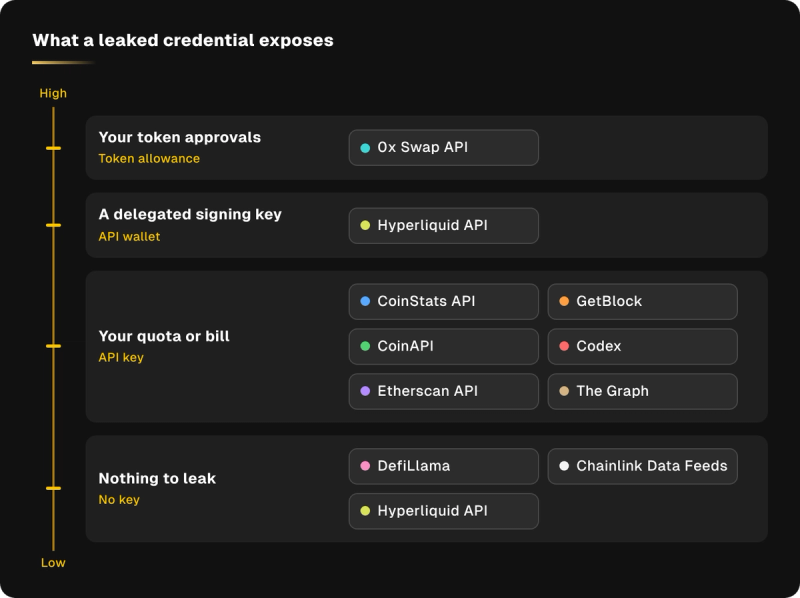
Keyless APIs sit at the bottom. DefiLlama's open endpoints and Chainlink reads expose nothing. Data keys sit one rung up. A leak there burns your credits or your bill. Rotate them, and never ship them in frontend code.
The top two rungs touch money. Hyperliquid lets you approve a separate API wallet to sign for the master account. Treat that key like a hot wallet. With 0x, approve tokens only to AllowanceHolder or Permit2, never to the Settler contract. 0x's docs warn a Settler allowance "will lead to misuse by other parties."
The same discipline applies on the user side. The TheHolyCoins scam prevention resources page lists tools for vetting a project first.
Final Thoughts
The right crypto API depends on the layer you are missing. Data-first products start with CoinStats API and add specialists as they grow. Execution-first products start with 0x Swap API or Hyperliquid API and buy data second.
Prices move fast. Within a year, Etherscan trimmed its free tier and 0x reworked its plans. The Graph moved its Token API. Re-check each pricing page before a launch. For the venues these APIs read, browse the TheHolyCoins exchanges directory. The crypto guides hub covers the rest.
Frequently Asked Questions (FAQs)
CoinStats API is the best fit for most crypto use cases. It returns market, wallet, DeFi, and portfolio data with a single key. Teams with one narrow need pick a specialist. Chainlink Data Feeds cover on-chain prices, for example.
DefiLlama's open API and Chainlink feed reads need no key. CoinStats API, GetBlock, Etherscan API, and The Graph set free caps. Codex charges a one-time $1 for its 10,000-request tier.
CoinStats API, CoinAPI, Codex, Etherscan API, and The Graph ship live-data MCP servers. DefiLlama's MCP needs its paid API plan. GetBlock, Chainlink, and 0x offer docs-focused MCP servers.
Not for reads. Data APIs like CoinStats API and Codex index the chain for you. You need a node, such as GetBlock, to broadcast transactions or run custom logic.
Entry plans run $49 a month at CoinStats API, GetBlock, and Etherscan API. Codex Growth starts at $350. The Graph bills $2 per 100,000 queries, and 0x charges 0.15% on select swaps.