On July 12, 2025, at 14:00 UTC, Pump.fun will launch a multi-exchange crypto token sale event for its native PUMP token, offering a supply of 150 billion tokens at a fixed price of $0.004 per token. According to the Pump.Fun announcement, the token sale will be hosted on six major centralized exchanges: Kraken, MEXC, Bybit, Bitget, Gate.io, and KuCoin, and is scheduled to close by July 15 or when the allocation is fully sold out.
To participate in the PUMP token launch, users must pass Know Your Customer (KYC) verification on the exchange platforms. Payment options include USDT, USDC, SOL, and other supported currencies. Pump.fun has stated that citizens from the U.S., U.K., and other restricted regions are excluded from participating. Unlike many crypto token launches with vesting periods, all PUMP tokens will be liquid and tradable approximately 48 hours after the sale ends.
What is Pump.fun? Solana Meme Token Launchpad Behind the PUMP Token
Pump.fun is a meme coin launchpad built on the Solana blockchain, known for enabling fast and permissionless token creation. Since going live in January 2024, the platform has supported over 11 million meme coin deployments, positioning it as arguably the most active token generator on Solana. Pump.Fun charges a fee for each token listing and liquidity pool created through its web-based interface.
The launch of the PUMP token marks the first native asset tied to the platform. According to the project’s whitepaper, the PUMP token will play a central role in incentivizing user activity, supporting liquidity systems, and funding product development. Upcoming features include social trading tools and creator-focused reward systems, powered in part by the PUMP token’s utility.
PUMP Tokenomics: Total Supply, Presale Allocation, and Fundraising Goal
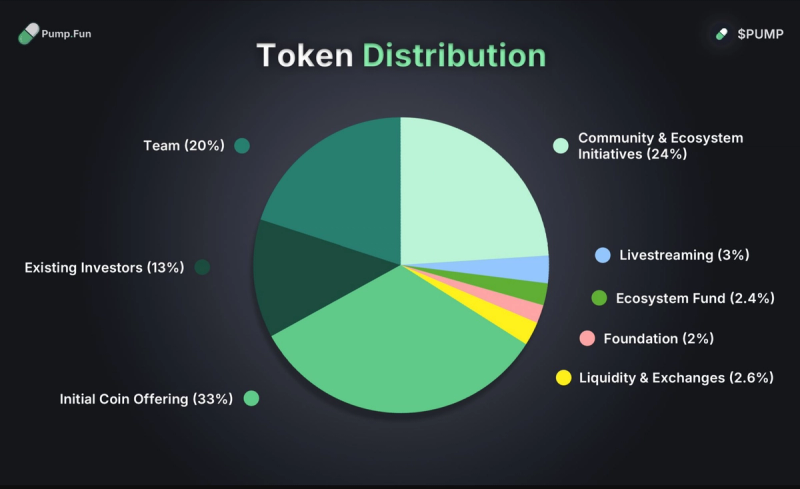
The PUMP token is deployed on Solana with a total supply of 1 trillion tokens. Of this, 15% (150 billion tokens) is allocated to the public presale. An additional 18% (180 billion tokens) has already been sold in a private sale. The remaining supply is distributed as follows: 24% for community and ecosystem growth, 20% to the Pump.fun team, 13% to early backers, 2.4% to an ecosystem fund, and 2% to the foundation. The fully diluted market cap at launch is $4 billion.
The current PUMP token sale is structured as a subscription-based offering with a fixed token price of $0.004, setting a potential fundraising cap of $600 million. Exchanges such as Kraken and Bitget have confirmed participation, aligning on sale terms and eligibility rules. Notably, all purchased tokens will be tradable shortly after the event, which sets this token launch apart from standard crypto presales that often include long lock-up periods or vesting schedules.
ICO Branding vs IEO Mechanics: Compliance Implications
Despite repeatedly referring to the event as an “ICO”, Pump.fun’s structure closely mirrors that of a multi-platform Initial Exchange Offering (IEO). Participants are not sending funds directly to Pump.fun; Instead, they subscribe through centralized exchanges like Kraken, Bybit, or KuCoin using verified accounts and exchange wallets.
Under the IEO model, exchanges conduct basic due diligence, manage the sale, and list the token soon after. This setup reduces investor risk and provides a compliance layer in response to growing regulatory scrutiny. Pump.Fun’s choice to label the offering as an Initial Coin Offering (ICO) appears to be symbolic or marketing-oriented rather than reflective of the technical structure. It may be a deliberate effort to suggest platform independence, despite relying on exchanges for fundraising and distribution.
IEO Explained: How the PUMP Token Sale Actually Works
An Initial Exchange Offering (IEO) is a fundraising event in which a cryptocurrency exchange hosts and manages the sale of a new token. Crypto investors use their exchange accounts to join the token sale, and the token is listed on the same exchange shortly after the event concludes. This model provides an added layer of trust, as the exchange acts as an intermediary and requires KYC verification.
In contrast, ICOs involve a direct connection between investors and the project, typically through the project’s website or a smart contract. The growing preference for IEOs stems from their compliance-friendly design and smoother listing processes. Despite Pump.Fun calling the event an ICO, its mechanics match the IEO model in nearly every way, from exchange hosting to compliance flow.
Final Thoughts on the PUMP Token Launch
With a $600 million target and backing from top-tier exchanges, Pump.fun's PUMP token sale stands out both in scale and execution. The unusual branding as an ICO, despite a clear IEO structure, raises questions about marketing intent versus regulatory positioning. Either way, the project is leveraging its massive user base and Solana’s infrastructure to push meme coins into a new phase of tokenized engagement.