Solaxy has officially launched its long-awaited Layer-2 blockchain, cross-chain bridge, and on-chain block explorer on July 7, 2025, at 14:00 UTC. This release marks the public deployment of its modular Layer-2 rollup infrastructure built on top of Solana.
As of launch, the Solaxy Layer-2 network is fully live and operational with its own RPC endpoint (https://mainnet.rpc.solaxy.io), a web-based bridge interface (https://bridge.solaxy.io), and a dedicated block explorer (https://explorer.solaxy.io).
Technical Overview of Solaxy’s Layer-2 Blockchain, Cross-Chain Bridge, and Block Explorer
The Layer-2 chain is structured as an optimistic rollup, executing transactions off-chain and posting compressed batches to the Solana Layer-1 for finality and data availability. Solaxy supports Solana-native programs through the Solana Virtual Machine (SVM), allowing existing Solana dApps to run on the L2 without modification. It also integrates a zero-knowledge virtual machine (zkVM), though the system currently runs in optimistic mode. The infrastructure is designed to reduce congestion on Solana by serving as an external execution layer.
The Solaxy Bridge connects Solaxy with both Ethereum and Solana via Hyperlane’s interoperability protocol. At launch, it enabled direct transfers between Solaxy and Ethereum, without needing to route through Solana. The bridge supports SOLX, SOL, and ERC-20 tokens from Ethereum. The block explorer allows users to track Solaxy’s real-time transaction history, block confirmations, and contract activity.
According to the team’s development updates, the Solaxy mainnet launch passed security review through a Cantina-hosted bug bounty program and included infrastructure aligned with the previously published rollout calendar. Upcoming integrations, such as the Neptoon DEX and Igniter launchpad, are scheduled to follow.
Solaxy Crypto Presale Background and Technical Role in the Solana Ecosystem
Solaxy was introduced as a modular Layer-2 rollup built on top of Solana, aiming to improve scalability and stability. It is designed to handle execution off-chain while relying on Solana Layer-1 for settlement. By supporting the Solana runtime environment, Solaxy enables developers to deploy their existing programs directly to the Layer-2 without adapting to a new architecture.
The crypto project raised over $58 million through its SOLX token presale held between late 2024 and mid-2025. $SOLX exists as both an SPL token and an ERC-20, with the Solaxy bridge allowing transfers between Ethereum, Solana, and Solaxy itself. With high throughput and complete EVM-Solana bridging via Hyperlane, Solaxy aims to make Solana more suitable for use cases like DeFi, NFTs, and low-latency gaming applications.
Community Feedback and Initial Market Reaction to Mainnet and Bridge Launch
Following the launch of Solaxy’s mainnet, the price of the SOLX token fell on exchanges from around $0.0013 to $0.0010, representing a 23% decline. At the time of writing, the token has partially recovered to $0.00117, representing a 10% decline from its pre-release price.
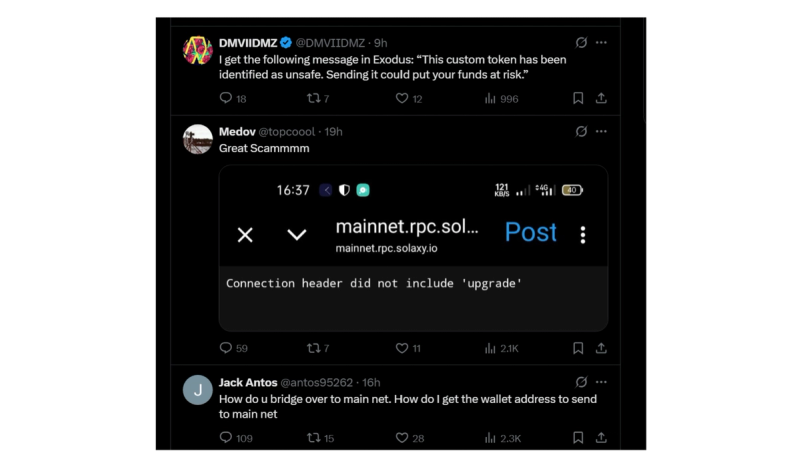
Some users attempting to visit the RPC endpoint at mainnet.rpc.solaxy.io via browser were confused by the on-screen message “Connection header did not include 'upgrade'.” This message is standard behavior for an RPC server and not a sign of malfunction; however, its appearance in a browser led to a temporary misunderstanding among users unfamiliar with RPC protocols.
The core infrastructure components (mainnet, bridge, and block explorer) have remained live and operational since release, with no downtime or confirmed technical issues reported.