The Apeing presale launched on September 8, 2026, and reports over $113,000 raised through sales of the APEING token. Yet its advertised $0.01 launch price implies a valuation approaching $160 million after existing burns, despite anonymous founders and no meaningful post-launch utility identified in its whitepaper. The sale is currently in Stage 6 at $0.0006 per token.
Apeing is an Ethereum meme coin built around a gamified presale, where participants compete through purchases and referrals to earn additional tokens. The project combines staged price increases, token burns, staking rewards, and public leaderboards to encourage early entry and continued participation. Its main features focus on attracting buyers and rewarding presale participation, rather than developing a separate product or service.
The project has a deployed token, three token security reports, a private KYC check, and recorded burns. However, the people running the sale remain unknown, and there is no detailed explanation of how the funds raised will be spent. Promotional articles emphasize 100x potential, while Apeing’s own disclaimer says investors should expect no financial return.
These gaps raise questions about whether Apeing is legit or if its presale shows warning signs of a potential scam. We examined Apeing’s whitepaper, public interfaces, client-side code, audit and KYC reports, marketing, and on-chain records to assess what investors are funding and whether the project’s promises hold up under scrutiny.
Apeing Presale Analysis: Key Findings
- Apeing is an Ethereum meme coin presale launched September 8, 2026, reporting over $113,000 raised. Its main features reward purchases, referrals, and staking, with no meaningful utility beyond those incentives.
- The advertised $0.01 launch price implies roughly $160 million FDV after burns, without any token or utility demand to justify it. Early purchase discounts and reward tokens could create substantial selling pressure.
- The team remains anonymous. Private KYC covers one person, while three token audits leave the complete fundraising platform outside their documented scope.
- Key safeguards remain unclear: no detailed spending plan for the funds raised, disclosed funded launch liquidity, or confirmed major partnerships.
- The roadmap targets Q1 2027, but the remaining weekly stages could extend the presale into April unless they sell out early.
- Marketing promotes 100x and 1000x narratives, despite Apeing’s disclaimer telling buyers to expect no financial return. We recommend staying away, although our findings do not establish fraud.
Apeing Whitepaper Offers Presale Incentives but No Meaningful Post-Launch Utility
The 25-page Apeing whitepaper explains how to encourage people to buy APEING far more clearly than why they would need it after launch. Staking tiers, referral rewards, leaderboards, and competitions encourage larger purchases and bring more buyers into the presale.
But what keeps that demand alive once the presale ends?
The whitepaper doesn’t mention a separate application, service, or revenue-generating business that would create demand beyond participation and speculation. Exchange listings would make APEING tradable, but availability alone does not explain why new investors would want it. Community interest could support demand, yet the document offers little explanation of how that interest would survive the end of presale incentives.
Apeing also promises a transition to on-chain staking after listing. However, distributing additional tokens does not, by itself, generate economic value. Investors may accumulate more APEING while still depending on future buyers to give those rewards a market value. The missing piece is a convincing reason for demand to outlast the buying incentives.
The development timeline raises another question: what has the team built beyond the machinery for selling and distributing tokens? The roadmap places the project’s foundation in Q3 2025, lists smart contract development as completed in Q4, and staking platform development as completed in Q1 2026, before the public presale launched in September.
Public presale interfaces exist, but the whitepaper does not distinguish between components the team developed and those supplied by external providers. Investors therefore have little basis for assessing the scope of the work or what substantial development remains.
The roadmap also schedules final security reviews and stress testing for Q1 2026, without providing testing methods, results, or an account of problems identified and resolved. Listing those milestones does not demonstrate that the platform was tested as described.
There is also no detailed use-of-funds plan. If the main fundraising features were already completed before the sale opened, what are investors now financing? A credible answer would link the requested funds to specific work, operating costs, and launch requirements. Token allocations show how tokens are divided; they do not explain where investors’ money will go.
The whitepaper gives investors detailed reasons to participate in the sale, but leaves the central question of what will make APEING worth acquiring once those incentives have served their purpose, unanswered.
Apeing’s Tokenomics Favor Presale Rewards, While Safeguards Remain Promises
Apeing allocates 40% of its token supply to the presale, 30% to staking, 15% to referrals, 10% to liquidity, 4% to community incentives, airdrops and burns, and 1% to the team. Together, staking and referral rewards account for 45% of the supply, exceeding the share sold to investors. The structure places considerable weight on incentives to buy, hold, and recruit other investors.
Larger purchases unlock higher staking rates, reaching 85% APY, and earlier access to rewards. The highest tier can claim rewards on listing day, while other tiers wait 14–60 days. These benefits encourage greater presale spending, but the rewards come from an existing token allocation rather than business revenue. More APEING does not necessarily mean more valuable holdings, and reward distributions could add selling pressure once they become claimable.

The 10% liquidity allocation also leaves a critical question unanswered: how much ETH or stablecoins will accompany those tokens? Setting aside APEING doesn’t mean the trading pool is deep. Apeing promises an 18-month liquidity lock from listing, but even a verified lock would not guarantee enough liquidity to absorb investor selling.

Apeing’s $0.01 Listing Target Implies a $160 Million Valuation
Apeing’s advertised $0.01 listing price implies a $167.5 million fully diluted valuation (FDV) before burns. Burns recorded by September 30 reduce that figure to $159.8 million. Further burns could lower it, but they don’t replace the demand needed to support that price.
That valuation is difficult to justify for an anonymous meme project with around $113,000 in reported fundraising, no explained revenue model, and no meaningful utility. An advertised listing target doesn’t determine what the market will pay once investors can sell.
The target is 100 times Stage 1’s $0.0001 purchase price and approximately 16.67 times Stage 6’s $0.0006 price. Those gaps also create an incentive to sell well below the advertised target. At $0.001, a Stage 1 investor would still receive ten times his purchase price, even though the token would be trading 90% below the listing target.
Later investors would face that selling pressure alongside any referral bonuses and staking rewards becoming claimable. Without sufficient demand and funded liquidity, the advertised gains could disappear before investors can realize them. Burning tokens reduces supply, but it does not supply the buyers or liquidity needed to absorb those exits.
Apeing’s Team Remains Anonymous Despite Its KYC Claim
Apeing advertises “full KYC,” but investors still cannot identify its founders, developers, executives, or the legal company responsible for the sale. Its materials provide no professional biographies or verifiable track record showing who is responsible for fundraising and delivery. A private identity check has not translated into public accountability.
The KYC claim does have supporting documentation. SCRL’s project page records verification of one person, a Bronze badge, and a GEO Tier 2 assessment. That supports a narrower claim than verification of the full operating team.
The KYC report, dated November 7, 2025, records passed identity, document, and screening checks. However, SCRL says it does not verify document authenticity with the issuing authority and instead relies on submitted documents, photographs, and videos. These checks offer some evidence of identity, but leave that independent confirmation absent.
The Bronze classification also has a limitation worth highlighting: SCRL reports that it found no prior project success or documented work experience to support the assessment.
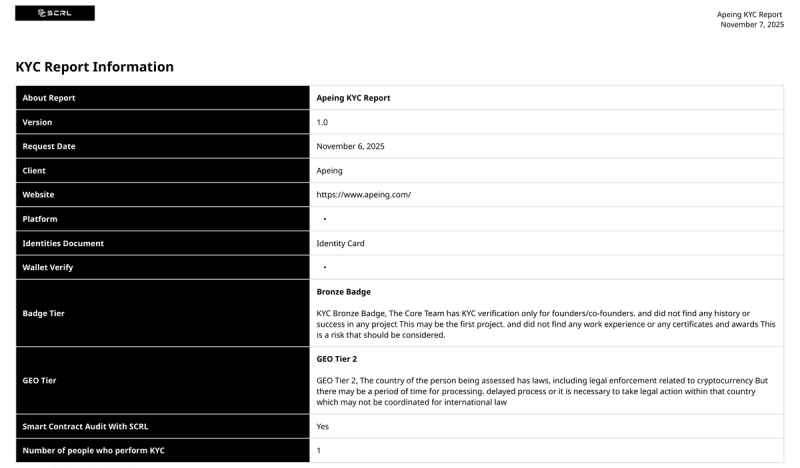
The report does not identify the person checked or confirm that they control the treasury and the project’s operations. Nor does it guarantee disclosure or recovery if investors lose money. SCRL explicitly warns that its KYC report doesn’t confirm that a project is safe to invest in.
Calling this “full KYC” risks giving investors a stronger impression of accountability than the evidence supports. One privately screened person is not equivalent to an identified operating company and a verified management team.
Three Token Audits Do Not Cover the Main Presale Risks
Apeing publishes reports from SpyWolf, Coinsult, and SCRL. These provide useful evidence about the token’s code, but don’t prove that the complete system collecting investors’ money and recording their entitlements has been audited.
SpyWolf’s November 14, 2025 report lists two low-risk findings involving allowance changes and unchecked arithmetic. It describes the arithmetic as safe under the current design, so the finding should not be presented as an exploitable flaw. Coinsult’s report, dated the same day, records no findings. SCRL’s November 6 assessment reviewed pre-deployment token source code and marked two informational findings as resolved.
The larger gap lies outside that token contract. The published reports do not document an end-to-end audit of payment reconciliation, backend balances, presale staking, referral calculations, or claim distribution. Coinsult includes basic website checks, but it doesn’t reflect on the security of the live fundraising backend. SCRL’s project page explicitly lists no available web penetration test.
SpyWolf also highlights a critical limitation: the entire initial supply was minted to the deployer, leaving distribution practices dependent on operational transparency rather than enforcement by the token contract. The absence of privileged token controls does not establish that allocations, vesting, or liquidity promises will be honored.
Investors therefore still depend on the developers to record purchases correctly, deliver tokens, and manage the proceeds responsibly. A token can function exactly as coded while its presale investors still lose their money.
Apeing Leaves Spending Undisclosed as Presale Schedule Extends Beyond Q1 Launch Target
Apeing has not published a detailed budget explaining how presale proceeds will be divided between development, marketing, operations, and exchange liquidity. Token allocations are not a spending plan. Without a cash budget, investors cannot assess how much funding the project needs or how much will support trading at launch. We also found no clear fundraising hard cap, soft cap, or financial reporting in the materials reviewed.
The roadmap targets presale completion and a DEX launch in Q1 2027, alongside market-making, liquidity management, and progress toward centralized exchange listings. However, the advertised stage schedule could push completion into Q2.
The sale has 33 stages, each lasting a week unless it sells out earlier. With Stage 6 scheduled to finish on October 6, another 27 full-week stages would take the presale to approximately April 13, 2027, beyond the roadmap’s launch window.
Earlier sellouts could bring completion forward, so the Q1 target remains possible. But meeting it requires stages to finish ahead of their weekly schedule. Investors should not treat that acceleration as assured.
Apeing’s Marketing Uses Unethical Return Claims to Sell the Presale
In our assessment, Apeing’s promotional campaign is unethical because it uses press releases and sponsored articles to promote extraordinary return scenarios and fear of missing out without demonstrating the demand needed to support those outcomes. The pitch centers on becoming wealthy through early entry.
One promotional article advertises “10,000% ROI” potential in its headline and includes a section titled “Get 100x Gains With Apeing Presale.” Its argument relies on project-stated prices, staged increases, and limited allocations, rather than demonstrated market demand.
Another promotional article invokes SHIB and TRUMP’s early winners before presenting Apeing as a possible successor. It illustrates how a hypothetical $100 purchase could become $10,000 at the proposed listing price. Although it acknowledges that returns are not guaranteed and depend on liquidity, demand, and selling pressure, repeated 100x and 1000x comparisons encourage readers to imagine similar gains from an unproven project.

The contrast with Apeing’s own disclaimer is enormous. It says the token has no intrinsic or monetary value, holders should expect no financial return, and Apeing is not an opportunity for wealth creation. Yet the promotional coverage builds its appeal around precisely those expectations.
Apeing’s Claimed Partnerships are Missing Confirmation
We found no confirmed major exchange or technical partnership supporting Apeing’s launch plans. The roadmap claims strategic partnerships were secured, but does not name the counterparties or explain their contributions.
The homepage displays logos for networks, wallets, platforms, and infrastructure services. Using those services, supporting their wallets, or appearing on their platforms doesn’t mean a partnership or endorsement. Those logos provide no independent backing for Apeing’s launch promises.
Final Verdict: Is Apeing Legit or a Potential Scam?
Apeing has a deployed token, token audits, a private KYC check, and verified burns. These are facts, but they are far from showing a credible investment. The developers remain anonymous, the published audits do not cover the complete fundraising platform, and investors have no detailed spending budget or clear explanation of meaningful post-launch utility.
The project’s strongest incentives encourage buying more tokens, recruiting buyers, and collecting rewards. Meanwhile, partnership claims lack independent confirmation, promised locks remain unverified, and the amount of funded launch liquidity is undisclosed. Its marketing promotes 100x scenarios without demonstrating the demand needed to sustain them.
We found no convincing basis for the approximately $160 million valuation implied by the advertised listing price after burns. Early entry, token rewards, and supply reductions cannot substitute for accountability, sufficient liquidity, and lasting demand.
We recommend staying away from the Apeing presale. Our findings do not prove fraud, but investors do not need proof of a scam to reject an anonymous team, weak safeguards, and a valuation built around speculative returns.