
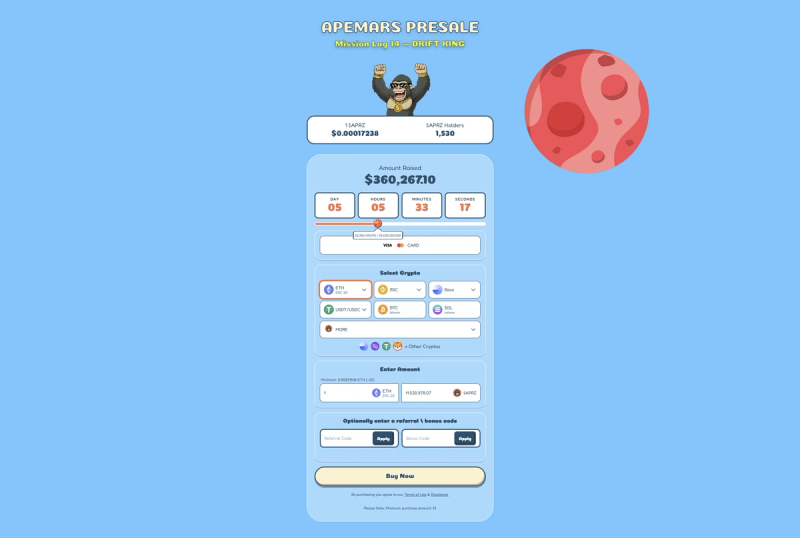
The ApeMars presale launched in January 2026 and, according to its official website, has raised around $360,000 to date by selling the APRZ coin as part of a themed crypto presale centered on a Mars mission narrative.
Unlike most crypto presales that claim to build a product, a protocol, or a decentralized application, ApeMars uses a story-driven model called “Operation Red Banana,” in which the presale is divided into 23 weekly stages, each tied to a fictional mission to Mars. The APRZ coin is being sold primarily on the presale experience and narrative, not on a future product.
This is unusual even for meme coin presales. Many recent projects at least present a roadmap linked to a working product or utility. Here, the ApeMars presale operates as a structured fundraising campaign first, with no clear product or technical system presented at this stage.
That gap between fundraising and product is the focus of this review. We examined whether ApeMars can justify the funds raised and whether the APRZ coin is backed by a real project, or if the ApeMars presale shows patterns commonly seen in crypto presale scams.
ApeMars Presale Analysis: Key Findings
- ApeMars has raised $360,000 so far, but allocations are not verifiable on-chain
- No working product, MVP, or clear utility behind the APRZ coin
- The whitepaper focuses on narrative, with no technical architecture or fund usage breakdown
- Team is fully anonymous, with no identifiable founders or legal entity
- Presale runs as a 23-stage fundraising campaign tied to a storyline, not product development
- Expected FDV ($385M) is high relative to the absence of a live product
- Marketing includes “100x” and high ROI projections across promotional coverage
- Audit covers only the token contract, not the presale system or fund handling
ApeMars Whitepaper: Narrative-Driven Presale Structure With Limited Technical Detail and Missing Financial Transparency
The ApeMars whitepaper reads more like a themed mission document than a technical or financial specification. The core concept described is a 23-stage presale structured as a “mission to Mars,” with each stage lasting about one week and including symbolic events such as burns, staking activation, and community tasks.
The document explains how price progression, story progression, and community engagement move together through these stages. The emphasis is on pacing, momentum, and participation rather than on a product or service.
Most of the whitepaper content focuses on narrative elements. It includes fictional mission logs, a character called “Commander Ape,” and symbolic connections between numbers and Mars-related data. For example, the staking APY is tied to Mars temperature, referral rewards are tied to orbital eccentricity, and stage counts are tied to distance to Mars. These elements are described in detail, while the technical implementation is not.
The utilities section lists three main mechanics: token burns at specific stages, a referral system that gives around 9% rewards, and community engagement campaigns such as meme contests and leaderboard challenges. There is no explanation of how these systems are implemented on-chain, how rewards are funded beyond allocations, or how sustainability is maintained after the presale phase.
There is no section explaining how presale funds will be used. The document does not break down budgets, development costs, liquidity allocation strategy, operational expenses, or treasury management. There is no mention of multisig wallets, custody structure, or how funds are controlled.
The document does not include technical architecture. There is no description of backend systems, smart contract interactions beyond ERC-20 basics, staking contract design, or any infrastructure supporting the “missions” or dashboard features. There is also no GitHub repository, no code references, and no explanation of how different components interact.
The roadmap included in the whitepaper focuses on presale execution, marketing activity, and post-launch expansion in general terms. It lists phases such as “Mission Assembly,” “Launch Sequence,” and “Colony Expansion,” but the listed tasks are mostly branding, marketing, and community growth. Later phases mention “partnerships,” “integrations,” and “utilities,” but do not define what those utilities are, how they will function, or what types of partnerships or integrations they involve.
The writing style itself reflects the document’s priority. Large sections are dedicated to storytelling and thematic continuity, while core areas expected in a crypto whitepaper, such as fund allocation, system design, risk management, and execution details, are either absent or briefly mentioned without depth.
Based on the content, the ApeMars whitepaper does not provide the level of detail and confidence usually expected when evaluating how a crypto project will operate, how funds will be used, or how long-term value will be created.
ApeMars Anonymous Founders, No Verifiable Identities, and Missing Background Information
The official ApeMars website and whitepaper do not list founders, developers, advisors, or any core contributors. There are no names, no LinkedIn profiles, no prior companies, and no verifiable track records connected to ApeMars. The domain and project materials also do not link to any legal entity, registered company, or jurisdiction associated with the people operating the presale.
The whitepaper and website content do not introduce any individuals. There are no team photos, no biographies, and no references to previous crypto projects, startups, or technical experience. This makes it impossible to verify whether the people behind ApeMars have relevant experience in blockchain development, smart contracts, AI systems, or financial infrastructure.
There is also no indication of third-party involvement at the team level. No known advisors, no external contributors, and no partnerships that would indirectly confirm who is building the product. In many crypto presales, even anonymous teams provide pseudonyms or partial histories. ApeMars does not provide that either.
There is also no information about the internal structure. The project does not explain who is responsible for development, marketing, treasury management, or security. There is no disclosure of who controls the presale funds or how wallet access is managed.
Because of this, there is no way to assess whether the team is trustworthy. If the project stops development, changes direction, or fails to deliver, there are no identified individuals to contact or hold responsible.
In its current state, ApeMars provides no verifiable information about who is running the presale, building the product, or controlling the funds.
ApeMars Presale Tokenomics: Pricing Structure, High FDV, and Launch Risks
The $APRZ coin has a fixed total supply of 70,000,000,000 tokens and is deployed as an ERC-20 token on the Ethereum blockchain. The allocation shown in the whitepaper is:
- 50% (35B $APRZ) allocated to the crypto presale
- 20% (14B $APRZ) allocated to staking rewards
- 20% (14B $APRZ) allocated to liquidity and ecosystem
- 5% (3.5B $APRZ) allocated to community rewards
- 5% (3.5B $APRZ) allocated to the team (locked)
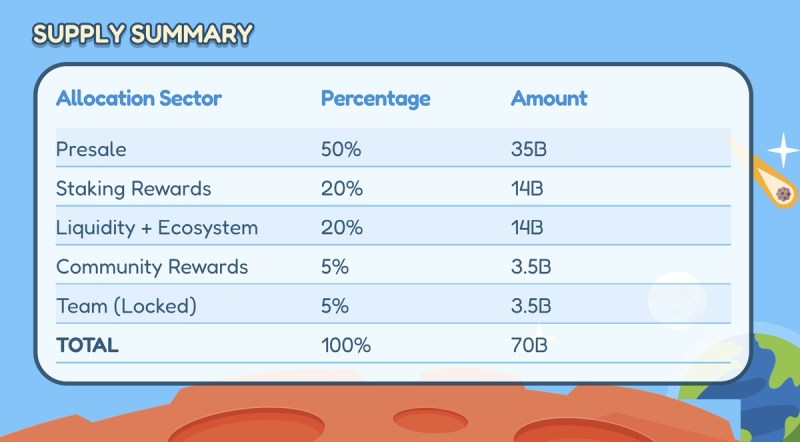
This structure is simple and not unusual for a crypto presale. A 50% presale allocation is common in early-stage token sales, and a 5% team allocation is relatively low compared to other projects. On paper, the distribution does not show extreme imbalance.
However, tokenomics need to be evaluated alongside pricing, staging, and valuation, not just percentages.
The ApeMars presale runs across 23 stages, with the token price increasing each week. The earliest stage price started at $0.00001699, while the promoted listing price is $0.0055. This is a price increase of roughly 323x from Stage 1 to listing.
This gap creates a strong incentive for early buyers to sell once trading opens. Even limited selling from early participants can create significant downward pressure on the token price at launch.
At the same time, the expected fully diluted valuation (FDV) at listing is around $385 million, based on the total supply and the listing price. This valuation is unrealistic for a project that does not plan to show a working product, public MVP, or deployed utility beyond staking, referrals, and presale mechanics.
Even at the current presale price of $0.00017238, the implied FDV of $12 million is very high. That is still a meaningful valuation for a token without a live application, user base, or verifiable product usage.
The tokenomics also include:
- 63% APY staking rewards, which introduce additional token emissions over time
- Burn events at stages 6, 12, 18, and 23, based on unsold tokens
- Referral rewards (~9.3%), which increase distribution through user acquisition
Overall, these mechanisms can support short-term engagement; however, the combination of a steep staged pricing model, a high expected listing valuation, and no confirmed product at launch increases the risk of a price drop after listing, as early holders may take profits while later buyers enter at significantly higher prices.
Aggressive Marketing vs Product Reality in the ApeMars Presale
ApeMars is promoted through a presale flow centered on urgency, staged pricing, and early entry, with little focus on the product itself.
The presale page shows countdown timers, price tiers, and repeated prompts to buy before the next increase. The content focuses on entry timing and token price progression, not on product usage. At the same time, external press releases and promotional articles present APRZ as a “100x crypto presale” with projected returns of thousands of percent.

The campaign (“Operation Red Banana”) uses meme-style branding and emphasizes early participation. The token is the core of the experience, whereas the product is not accessible. No GitHub, testnet, or verifiable system is available at this stage.
This structure is common in crypto presales, where marketing leads and the product may follow, if at all. In similar cases, heavy presale marketing combined with high return projections led to selling pressure at the time of listing, as early buyers hold significantly lower-cost tokens.
ApeMars shows the same pattern: active fundraising, high promotional exposure, and no product usage. All the coverage appears on sponsored or promotional channels, with limited organic discussion or developer activity.
No Product, No Development Plan, and No Explanation of Fund Usage
ApeMars is raising funds through a crypto presale, but there is no clear product being built and no explanation of how the funds will be used.
The only working system is the presale launchpad. Users connect a wallet, send funds, and view their balance on the site. There is no application, platform, tool, or service connected to the APRZ token. There is no use case for the token today.
The roadmap does not describe a product. It shows stages of the presale, token distribution, liquidity setup, and marketing expansion. It does not list a system being developed, a feature being released, or a timeline for a usable product. Later phases mention “utilities” and “partnerships,” but they are not defined.
There is no MVP, no beta, no demo, and no public development activity. There is no GitHub, no testnet, and no working environment. The only technical component visible is a basic ERC-20 token contract, which does not represent a product.
The project materials do not include a budget or allocation plan for the funds raised. There is no breakdown showing how much goes to development, operations, liquidity, or any other category. There is no indication of hiring, infrastructure, or engineering work tied to the funds collected.
In practice, the current setup shows funds being collected without a product, without a development plan, and without a clear explanation of how the money is used.
ApeMars Audit Analysis: What SolidProof Reviewed, What Was Excluded, and What It Means for Investors
ApeMars links its audit to SolidProof through its TrustNet platform, where the APRZ token contract was reviewed. The report shows no high or medium severity issues and describes the contract as a standard ERC-20 implementation.
It explains that the contract has a fixed supply, no mint function, no blacklist capability, no proxy pattern, and no upgrade mechanism. Ownership is described as renounced, meaning no admin control remains over the token contract itself.
The same TrustNet page explains that the audit did not include functional testing and did not review any other contracts linked to the project. It explicitly states that SolidProof audited only one token contract and did not assess any additional systems.
In practice, the audit confirms that a basic ERC-20 token contract passed a limited security review at a specific point in time. It does not confirm that the presale system works as shown on the website, does not confirm how funds are handled, and does not confirm that users will receive tokens according to the dashboard balances.
This type of audit is common in crypto presales. It reduces the risk of simple smart contract bugs, but it does not eliminate the main risks in this setup, which stem from off-chain accounting, delayed token distribution, and systems not covered by the audit.
Final Verdict: Is ApeMars ($APRZ) a Legit Project or a High-Risk Scam Setup?
ApeMars is raising funds through a crypto presale, but there is no working product, no MVP, and no clear utility behind the APRZ coin. The only system available is a presale dashboard where users send funds and see balances recorded off-chain, with tokens promised later. This setup means buyers cannot verify allocations or ownership on-chain at this stage.
The project does not explain how funds are used, does not provide a development plan, and does not show what is being built. The team is fully anonymous, with no company, no identities, and no accountability. These are common risk factors seen in crypto presales that later failed or were linked to scams or fraudulent fundraising.
The audit covers only a basic token contract and does not include the presale system, fund handling, or token distribution. At the same time, the marketing environment includes extreme ROI projections often seen in high-risk or misleading crypto campaigns. This combination increases the risk of loss even if the project is not explicitly proven to be a fraud.
Based on the available evidence, ApeMars does not show clear indications of a legit project. The structure relies on trust, lacks transparency, and shows multiple red flags associated with scam or fraud patterns in crypto presales. Until there is a working product, verified fund handling, and an identifiable team, this should be treated as a high-risk setup with potential scam characteristics.