When we first heard about Crypto All-Stars and its ambitious MemeVault Ecosystem during the $STARS token presale, we approached it with cautious optimism. The idea of unifying multiple cryptocurrency meme coins on a single platform offering substantial staking rewards sounded intriguing.
The project concluded its presale in December 2024, raising $25.3 million before launching the $STARS token on exchanges. Since then, the token has dropped by more than 99% from its post-launch levels.
But as we dug deeper into the Crypto All-Stars project, doubts began to surface. The project’s anonymous team, vague technical details, and the promise of incredibly high-stakes rewards raised serious concerns. While the concept is appealing on the surface, there are enough warning signs to warrant a closer look before jumping in.
In this review, we’ll examine these concerns to help the crypto investor community assess whether Crypto All-Stars is a legit project or a potential scam.
Crypto All-Stars' Vision: The World's First MemeVault Ecosystem and $STARS Token
According to its whitepaper, Crypto All-Stars introduced the concept of the “MemeVault Ecosystem,” a platform designed to allow holders of different meme coins to earn staking rewards through the project’s native $STARS token. The idea behind the platform is to bring together several popular meme assets under a single staking environment where users can deposit tokens and receive rewards denominated in $STARS.
The system is built around the ERC-1155 multi-token standard, which allows multiple token types to be handled within a single smart contract. In theory, this architecture enables a platform that can support multi-token staking across multiple meme coins, potentially allowing users to stake assets such as Dogecoin, Shiba Inu, Pepe, and others within the same ecosystem.
Following the completion of its presale and the launch of the $STARS token, the project released a live interface for the MemeVault platform, accessible through the Crypto All-Stars website. The dashboard allows users to connect a wallet and interact with the staking interface that is intended to distribute rewards in $STARS.
However, an examination of the current implementation raises questions about how fully the system reflects the functionality described in the whitepaper. While the interface is publicly accessible and wallet connections are supported, the platform’s available features appear limited. At the time of writing, reward parameters and staking activity appear minimal, and it is unclear how widely the vault is being used or whether the full multi-token staking model described in the project documentation has been implemented.
This gap between the original MemeVault vision and the currently observable functionality is significant. For investors, the key question is not only whether the interface exists, but whether the ecosystem actually delivers the cross-token staking utility and reward mechanisms presented during the presale stage.
Given that the project claims to have raised $25.3 million during its fundraising campaign, the limited functionality currently visible on the platform raises questions about whether the delivered product reflects the scale of resources allocated to the project.
The Team Behind $STARS: Anonymity Raises Scam Questions
One of the first concerns we identified while reviewing Crypto All-Stars is the lack of transparency about the project’s team. The official website and whitepaper do not disclose the identities of the founders, developers, or executives responsible for building the platform.
There are no publicly available doxxed team members, LinkedIn profiles, or professional biographies, making it difficult to verify the experience or background of the individuals responsible for the project.
The project also does not disclose any Know Your Customer (KYC) verification, third-party identity checks, or a publicly registered company behind the operation. Without identifiable leadership or a transparent organizational structure, there is no clear accountability if the project fails to deliver on its promises.
While anonymous teams are not uncommon in the cryptocurrency industry, the absence of verifiable leadership or accountability may raise concerns for some investors when evaluating whether the Crypto All-Stars project is legitimate or potentially risky.
Crypto All-Stars Whitepaper: Marketing Claims vs Technical Transparency
The Crypto All-Stars whitepaper presents the project as an attempt to unify several meme coins within a single staking ecosystem through its proposed MemeVault platform. The document highlights the concept of cross-token staking and positions the $STARS token as the central reward mechanism that powers the ecosystem.
Much of the whitepaper focuses on describing the broader vision of creating a shared staking environment for popular meme assets. It repeatedly emphasizes the idea of bringing multiple meme coins together on a single platform, supported by the ERC-1155 multi-token standard and the distribution of staking rewards in $STARS.
However, while the document outlines the project’s general concept, it provides limited technical detail on how the platform is implemented. The whitepaper does not include in-depth explanations of the system architecture, smart contract structure, or the technical processes required to support multi-token staking across different assets.
In addition, the document offers very little information about the development process itself. There are no detailed technical diagrams, engineering explanations, or clear implementation milestones that would normally help readers understand how the platform is being built or how its different components interact.
The roadmap included in the documentation also remains relatively high-level, outlining general development phases without providing specific timelines, development updates, or verifiable progress indicators.
For investors evaluating the project, the whitepaper therefore functions more as a conceptual overview of the MemeVault idea than as a detailed technical document explaining how the system operates under the hood. While this approach is not uncommon among meme-themed crypto projects, it makes it more difficult to independently assess the platform’s feasibility and long-term sustainability based solely on the information provided in the official documentation.
Crypto All-Stars Staking Rewards: Are 1,005% Returns Realistic?
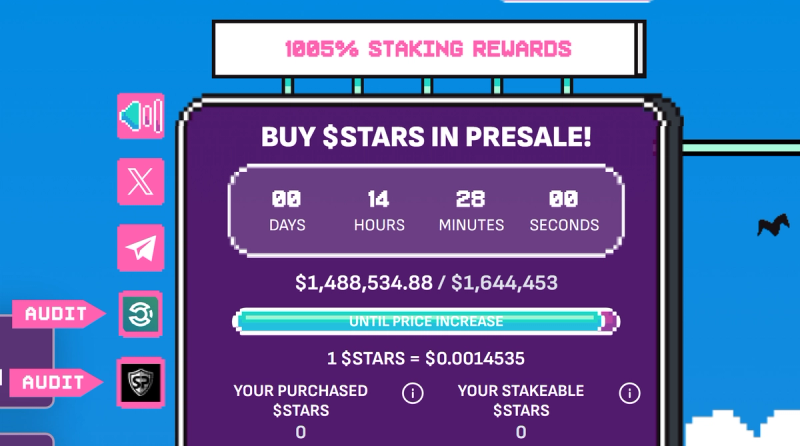
During the Crypto All-Stars presale, the project promoted staking rewards of up to 1,005% APY, a figure that immediately stands out. While high yields can attract attention in the cryptocurrency sector, returns of this magnitude raise questions about how such rewards can be sustained over time.
In most cryptocurrency ecosystems, staking rewards are typically generated through network activity, transaction fees, or other economic mechanisms within the platform. In the case of Crypto All-Stars, the available documentation does not clearly explain how these rewards would be funded beyond the distribution of newly issued $STARS tokens from the project’s allocation pool.
When staking rewards rely primarily on the issuance of additional tokens rather than revenue generated by the platform itself, the model often depends on continued demand for the token to maintain its value. Without a clear economic engine supporting the reward system, extremely high APYs can be difficult to sustain over the long term.
For this reason, the advertised 1,005% staking reward rate should be viewed as a warning sign, as the project did not demonstrate a sustainable mechanism capable of supporting such returns.
Audit, Security, and Technological Claims: Is MemeVault Verified?
Crypto All-Stars promotes its platform using phrases such as “Battle Tested Technology” and “Revolutionary MemeVault Protocol.” The project also states that its smart contracts have been audited, suggesting a level of security and reliability for the ecosystem.
However, a closer review shows that the available audit reports appear to cover only the $STARS token smart contract itself, rather than the broader MemeVault system that forms the core of the project’s value proposition. The MemeVault platform, which is described as supporting multi-token, multi-chain staking, does not appear to have undergone an independent public audit.
This distinction is important. While auditing a token contract helps verify that the token cannot be easily manipulated or exploited, it does not guarantee the security of a separate staking infrastructure or platform logic.
If the MemeVault is responsible for handling deposits, rewards distribution, and interactions between different tokens, its underlying contracts and architecture would typically require their own security review.
The project also references the ERC-1155 multi-token standard as part of its technological foundation. However, the available documentation offers only a limited technical explanation of how this standard is implemented in the MemeVault system or how cross-token staking is handled.
Without a publicly available audit of the full MemeVault infrastructure or detailed technical documentation explaining its architecture, it remains difficult to independently verify the security and robustness of the platform’s most important component.
Marketing Over Substance: Is It Crypto All-Stars Marketing Over Substance: Is It Just Hype?
The Crypto All-Stars website and whitepaper rely heavily on ambitious marketing language to describe the potential of the $STARS token. Phrases such as “massive reward potential” and “a globally dominant force in the cryptocurrency market” appear throughout the promotional material.
While strong marketing is common in the cryptocurrency industry, the underlying documentation provides relatively limited technical detail explaining how these outcomes would realistically be achieved. Much of the messaging focuses on the scale of the vision rather than the practical mechanisms required to deliver it.
This imbalance between bold marketing claims and limited technical explanation makes it difficult to evaluate the feasibility of the project’s long-term goals. For investors conducting due diligence, distinguishing between promotional messaging and verifiable development progress becomes particularly important when assessing projects at the presale stage.
Media Coverage and Affiliate Marketing: A Conflict of Interest?

During our research, we found several highly promotional articles about Crypto All-Stars published on various mainstream cryptocurrency news and research websites. Many of these articles present the project in an overwhelmingly positive light and frequently include optimistic price forecasts for the $STARS token.
Several of these publications appear to include links that direct readers to the Crypto All-Stars presale page, which may function as affiliate or referral links. In such arrangements, the publisher can receive compensation when readers purchase tokens through those links.
If financial incentives are tied to these referrals, it creates a potential conflict of interest, as the publication may benefit from promoting the project rather than providing a critical evaluation of its risks. For this reason, investors should approach promotional articles with caution and rely on independent research and primary documentation when assessing projects like Crypto All-Stars.
Business Model Sustainability: Unanswered Questions
Another important aspect when evaluating any cryptocurrency project is the economic model that supports its long-term sustainability. In the case of Crypto All-Stars, the available documentation provides limited detail about how the MemeVault ecosystem or the $STARS token is expected to generate ongoing value.
The project promotes high staking rewards and positions $STARS as the central token within the MemeVault platform. However, the documentation does not clearly explain what revenue streams, economic activity, or platform usage would support these rewards over time.
In many blockchain ecosystems, staking rewards are funded through network activity, transaction fees, protocol revenue, or other economic mechanisms. In the case of Crypto All-Stars, it appears that the rewards are primarily funded through token allocations reserved for distribution, rather than through a clearly defined revenue-generating model.
Without a transparent economic engine supporting the reward system, the ecosystem’s long-term sustainability is difficult to evaluate.
Lack of Product Demonstrations and Technical Roadmap
Transparency around product development is another important factor when assessing early-stage cryptocurrency projects. Investors usually expect to see clear development milestones, technical roadmaps, and evidence of ongoing progress, particularly for projects that introduce new infrastructure or protocols.
Crypto All-Stars does provide access to the MemeVault interface, allowing users to connect a wallet and interact with the staking platform. However, beyond the interface, there is limited publicly available information about the underlying development process, the system architecture, or the progress of the future features described in the project documentation.
The project also does not provide a detailed technical roadmap with clearly defined development stages or timelines. Without transparent milestones or regular development updates, it becomes more difficult for observers to evaluate how the project is progressing or whether the broader vision described in the whitepaper is being implemented over time.
For investors conducting due diligence, the availability of clear technical documentation and transparent development can be important factors when assessing the credibility of a new blockchain platform.
Conclusion: Multiple Red Flags Resembling Patterns Seen in Crypto Scams
Crypto All-Stars presents an ambitious vision centered around the $STARS token and the MemeVault staking ecosystem, but a closer examination reveals a number of warning signs that closely resemble patterns frequently seen in high-risk crypto projects and potential scams.
Throughout this review, several major red flags emerged: a fully anonymous team with no verifiable identities, limited technical transparency in the whitepaper, extremely high staking reward claims, and the absence of independently audited infrastructure for the platform’s core MemeVault technology. While the project promotes a revolutionary staking ecosystem for meme coins, the currently observable implementation appears far more limited than the scale of the promises presented during the presale.
These factors do not automatically prove that Crypto All-Stars is a scam. However, the combination of aggressive marketing, limited technical transparency, and minimal accountability from the team closely mirrors characteristics observed in numerous past crypto scams.
For these reasons, the Crypto All-Stars ($STARS) project should be considered extremely high risk, and readers should approach it with caution when evaluating whether it is a legitimate project or a potential crypto scam.