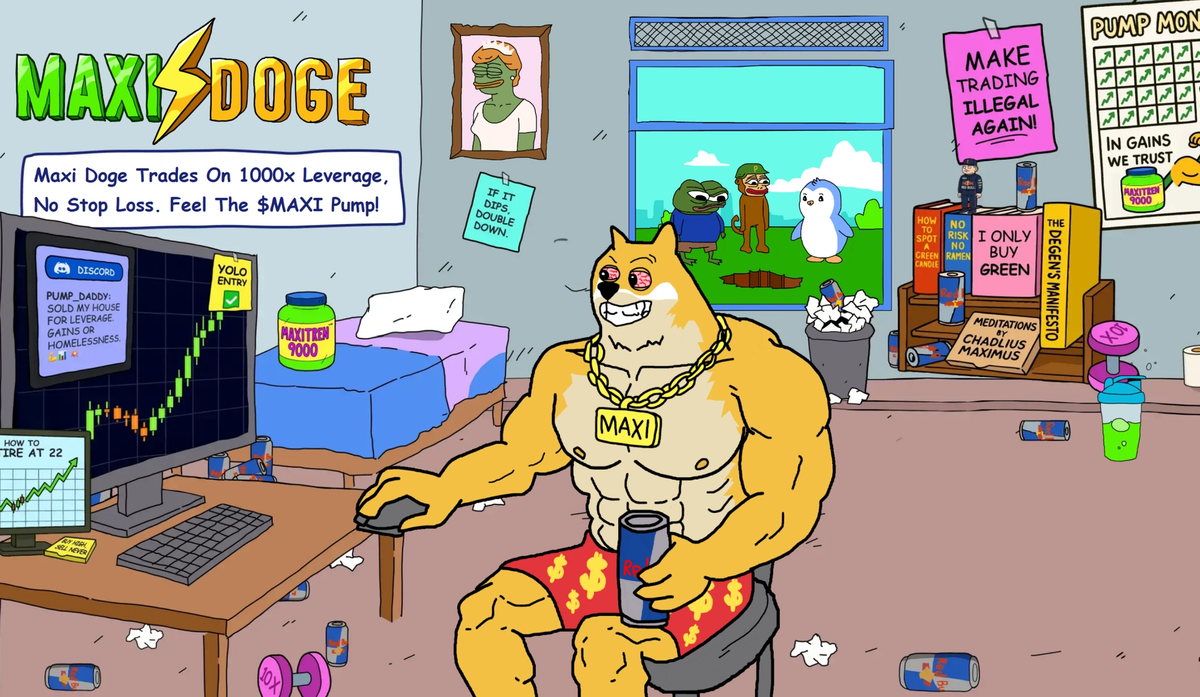
The Maxi Doge presale, launched in July 2025, has raised nearly $4.7 million to date. The crypto project is a meme-themed gym-and-trading parody built around the MAXI token and promoted as a cultural icon for high-risk, high-reward traders.
The meme focuses on extreme leverage betting (x1000), parodying the mindset of degen traders who chase explosive returns regardless of risk.
Although the project acknowledges that it doesn't offer real utility and focuses more on “vibes” and community entertainment, it continues to attract a large number of retail investors.
So why does a project with no tangible utility need to conduct a large crypto presale?
This review examines the whitepaper, tokenomics, team background, audits, and marketing strategies to determine whether the MAXI token represents a legitimate opportunity or a potential crypto scam disguised as a hype-driven presale fundraising.
Maxi Doge Whitepaper and Compliance Attempt
The 9-page Maxi Doge whitepaper resembles many other short presale documents: it’s visually flashy but lacks substance. What stands out most is its attempt to appear compliant with MiCA regulation, including disclaimers that the document is “fair, clear, and not misleading”.
It describes the MAXI token as a cultural meme coin built on Ethereum that offers staking rewards, trading competitions, and “partner events”. However, these features are described only in broad terms with little technical detail or implementation plan. Beyond community contests and staking, the document offers no clear roadmap or explanation of how the team intends to deliver these features.
The whitepaper doesn’t outline any concrete strategy for how Maxi Doge plans to use the millions it is raising. Given the scale of funds already raised, the absence of a structured spending plan raises concern. There’s no breakdown of the development costs, no hiring plans, and no metrics.
It's also unclear what technical infrastructure is being built, if any. For a presale of this size, the document reads more like marketing material than an actionable plan.
Bottom line: for a project raising millions from retail investors, the whitepaper feels superficial. It uses compliance language without providing concrete plans, leaving significant uncertainty about how the raised funds will be used.
Tokenomics and MAXI Presale Structure
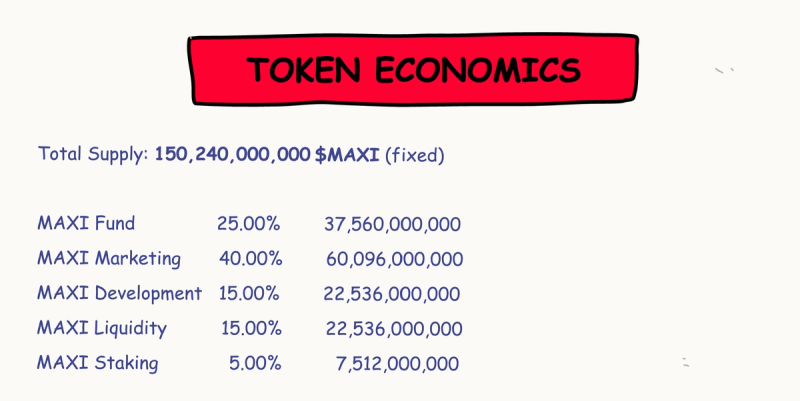
The Maxi Doge tokenomics appear simple at first glance. The presale is divided into 50 stages, with token prices increasing slightly with each round, and the project reports a fixed total supply of 150.24 billion MAXI tokens. However, the structure raises several concerns.
The token allocation is as follows:
- 40% — Public presale
- 25% — Maxi Fund
- 15% — Liquidity
- 15% — Team allocation
- 5% — Staking rewards
While the allocation appears organized, it lacks critical details, such as token vesting schedules and a clear disclosure of the number of tokens sold in the presale. This opacity allows the team to sell as many tokens as possible at the elevated presale price without being held accountable.
No information is provided about vesting for the team allocation or how the Maxi Fund will be managed, two critical elements that determine post-launch stability.
For a meme coin with no working product, the structure looks more like a capital grab than a well-planned token sale, raising the risk that Maxi Doge could resemble a soft scam rather than a serious crypto venture.
The Anonymous Maxi Doge Team and Corporate Setup
The Maxi Doge team is entirely anonymous. No developers, marketers, or founders are identified on the official website or social media.
As part of its purported MiCA compliance, the project lists “Maxi Doge Labs Ltd” as its issuing entity, which, according to the marketing materials, is incorporated in Costa Rica. However, as of the time of writing, the whitepaper still states that the incorporation process is in progress, nearly four months after the presale began.
The team has not undergone any KYC verification by an independent third party. An anonymous team raising millions of dollars is always a significant risk indicator, especially where no product exists. Even if the Costa Rican entity were fully registered, its jurisdiction offers little transparency or legal recourse for investors.
Rather than ensuring accountability, this setup effectively conceals the developers’ real identities and shields them from potential repercussions if things go wrong.
Maxi Doge Token Audits and Security
According to the official site, Maxi Doge’s smart contract was audited by Coinsult and SolidProof, two firms known for conducting basic ERC-20 audits.
Both reports found no critical vulnerabilities, such as minting, blacklisting, or ownership abuse functions. On a technical level, the MAXI token contract appears safe from typical rug-pull mechanisms.
However, audits alone don’t guarantee investor safety. These reviews confirm that the contract code behaves as expected, but they do not address how funds raised are handled or whether the team’s promises will be kept.
The staking system and reward distribution, for instance, were not covered in the published audit results. For a project collecting millions, limiting the audits to a standard token contract feels minimal rather than thorough.
FDV and Valuation Concerns
Investors buying the MAXI token at the current presale price are entering at a fully diluted valuation (FDV) of around $42 million, calculated as 150.24 billion total tokens multiplied by the current price of $0.0002809. This valuation is high for a meme coin with no working product, anonymous founders, and uncertain long-term goals.
To put this into perspective, a $42 million FDV is comparable to a small but established crypto startup with working applications, staff, and audited financial operations. In contrast, Maxi Doge currently offers only a basic website, a staking interface, and marketing claims. Investors are essentially paying a premium for hype and branding rather than fundamentals.
As seen in many presales and meme coin launches, excessive FDVs at launch often create intense price pressure. Early buyers, seeking quick profits, tend to cash out en masse, driving the token price down toward a more realistic valuation.
Without strong fundamentals or utility to support the initial market cap, such projects frequently suffer steep post-launch declines. In Maxi Doge’s case, the gap between valuation and actual development progress raises similar concerns.
Overall, Maxi Doge’s valuation appears disconnected from its tangible progress, suggesting speculative pricing based on branding rather than fundamentals.
Marketing Strategy and Influencer Exposure
The Maxi Doge presale is heavily marketing-driven. The project has allocated up to 40% of the raised funds for marketing and an additional 25% for the “Maxi Fund”, which is also used for exposure and partnerships. This means nearly two-thirds of investor money is allocated for advertising campaigns, influencers, and PR.
Indeed, hundreds of sponsored articles have been published on sites such as CoinSpeaker, Techpoint Africa, Digital Journal, and Yahoo Finance, all carrying similar wording and structure. The campaign spans YouTube, X (formerly Twitter), and Telegram, utilizing meme content to attract retail traders.
Another problematic element is the project’s promotion of the staking rewards. Early press releases advertised staking rewards at several hundred percent APY, a level unsustainable for any token economy.
As of this writing, the official website still promotes staking returns of around 67% APY, which remains extremely high for a token with no underlying revenue model or economic activity to support those rewards.
While the strategy is effective in generating attention, it highlights that Maxi Doge’s primary product is marketing itself rather than any underlying utility.
MiCAR Regulation and Compliance Reality
While the Maxi Doge whitepaper contains disclaimers and refund terms resembling MiCA Regulation language, its actual compliance appears superficial. The 14-day refund policy and issuer details are presented as proof of alignment with MiCA, but in practice, the project is not operating under any formal supervision.
Several key compliance requirements are missing:
- No disclosure of the management body's names, addresses, and roles as required by MiCA whitepaper guidelines.
- The whitepaper lacks core MiCA-required content, including the technology stack, development milestones, and a structured funding allocation.
- No whitepaper submission or notification to any EU competent authority before public offering or marketing activities.
- The listed Costa Rican entity is used to avoid identification of the actual offeror or issuer, contrary to MiCA’s requirement for complete offeror transparency and jurisdictional accountability within the EU.

The MiCA-styled wording appears designed both to build investor confidence and act as a legal buffer, rather than to indicate real adherence to EU crypto-asset standards. This pseudo-compliance may give investors a false sense of legal protection, despite the lack of regulatory oversight.
Conclusion: A Meme Coin Presale With Red Flags
The Maxi Doge presale combines humor, fitness memes, and leveraged-trading culture into a marketable brand, but beneath the surface, it raises several red flags.
The whitepaper lacks substance, the team remains anonymous, the valuation is inflated, and the company registration appears to serve compliance optics more than genuine transparency.
While it’s not outright labeled a scam, Maxi Doge shows several warning signs typical of projects that later collapse or quietly disappear. For retail investors, this project illustrates yet again how modern meme coins use polished marketing and regulatory language to create the illusion of legitimacy.
A solid crypto project focuses on building verifiable products, transparent teams, and measurable results, not on raising millions through promotional storytelling.
In our view, investors should exercise extreme caution. The MAXI token represents a high-risk presale where much of the value lies in hype rather than deliverables. Until transparency, verified compliance, and tangible development are demonstrated, treating the MAXI presale as a speculative gamble rather than an investment is the safer approach.