Qubetics is a Layer-1 blockchain aggressively marketing its $TICS presale, which has been underway for the past six months and is nearing its conclusion. At the request of one of our readers, we have conducted an in-depth review of the project. It's not every day we find a crypto presale raising millions for an ambitious product and a fully doxxed team. This review of the Qubetics crypto presale examines every detail—from the whitepaper to the team credentials—ensuring you understand whether the $TICS coin is worth your attention.
Qubetics claims to offer cross-chain compatibility, a gasless transaction system, quantum-resistant security, a cryptocurrency wallet, a decentralized VPN, and a smart contract IDE with AI support—facilitating efficient dApp development and seamless integration with Decentralized Finance (DeFi) protocols in a crowded market. But with over 27 presale stages completed, an extensive list of future plans, and millions already raised, we had to ask: Is the Qubetics coin legit, or another digital crypto scam in disguise?
Let’s dig in.
Qubetics Crypto Whitepaper Analysis and Technical Content Review
The Qubetics whitepaper is over 50 pages, and covers many aspects of the blockchain ecosystem. We are not claiming to be blockchain Layer-1 experts or anything of that sort, so please keep that in mind. However, after reading several Layer-1 blockchain whitepapers, we believe we have sufficient relevant knowledge and common sense to determine the overall direction.
While the whitepaper is lengthy and appears detailed, we found several issues:
- There is a lot of generalized content—the kind of information that could be found in any other EVM-based blockchain whitepaper applicable to many other Layer-1 blockchains.
- Too many vital sections are flagged with AI probabilities ranging from 50% to 98%.
- There is a lack of focus, with an overwhelming number of products and feature offerings. This Layer-1 blockchain is also a Web3 aggregator of other Layer-1 blockchains, featuring a dedicated IDE technology and support for AI-driven development, a decentralized VPN (dVPN), a non-custodial Qubetics wallet integrated with Visa and Mastercard, virtual card capability, a tokenized asset marketplace, and several other products and features.
- While there is some technical information and several drawings, they also seem generalized and do not provide real value.

We do not know who wrote the Qubetics whitepaper. Since the entire team, except for Yaqubi (the CEO), joined the project around the start of the fourth quarter of 2024 after the whitepaper was released, we think that Yaqubi may have written it, though we cannot be certain. It could also be someone from the Antier development company (which we will discuss in the next section). It seems to us that the whitepaper needs an update to reflect the current state and provide more technical explanations.
Qubetics Team Blockchain & Crypto Credentials and Background Verification
The Qubetics team is fully doxxed and consists of Shaffy Yaqubi (CEO), Matthew Collins (COO), Winn Faria (CTO), and Karan Chopra (Technical Project Manager). The team’s credentials, on paper, are strong and verifiable via LinkedIn and other profiles. Aside from Yaqubi, the rest of the team appears qualified for their positions. However, Yaqubi does not seem to have adequate and relevant prior experience to lead a blockchain startup valued at hundreds of millions. His personal website, where he portrays himself in formal business suits and adopts unusual poses, comes off as somewhat narcissistic.

LinkedIn shows Yaqubi founded Qubetics in January 2024, and Collins joined in September 2024. We have limited information on Faria and Chopra, though we assume they joined in the fourth quarter of 2024. Had they been founding members, they would likely have been presented alongside Yaqubi from the start.
The Qubetics Layer-1 blockchain, crypto wallet, and other products and features are developed by a solid Indian development company called Antier. Relevant team members from Antier participate in the AMAs, and the company appears to be developing a real product.
Before 2024, we could not find any webpages or articles with information about Yaqubi, or any social accounts detailing his activities. Nowadays, he participates in blockchain conferences and marketing videos, but we would expect to have more information on him before the launch of Qubetics.
Qubetics Crypto Marketing Strategies, Price Predictions, and Public Relations
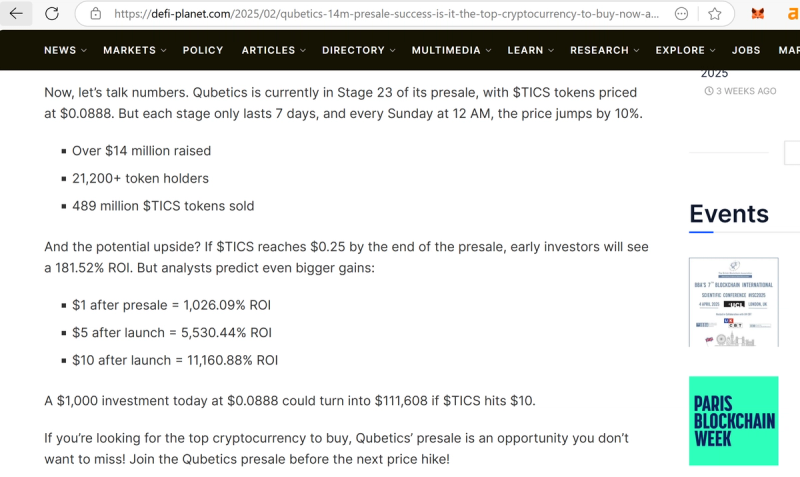
Although not promoted by Clickout Media, the marketing campaign for Qubetics crypto is intense and lengthy. So much sponsored content and press releases have been published, with substantial funds spent on marketing. In one of the Qubetics marketing articles, we were disappointed to see a price prediction estimating that crypto investors in the $TICS coin could achieve returns of 11,160.88% if the token reaches $10. This speculative profit promise is a classic marketing tactic designed to capitalize on retail FOMO. While the likelihood of fulfilling such promises is exceptionally slim, these tactics are more suitable for questionable crypto projects rather than a Layer-1 blockchain project. We did not find independent analysts (unaffiliated with the project) praising it; most of the favorable coverage originates from Qubetics’ own PR efforts.
For complex blockchain technology projects, crypto ventures should secure pre-seed/seed funding from professional investors, begin product development, and then launch the digital token presale once a more robust product is in place. That approach would have allowed the cryptocurrency project to spend much less on marketing and present a more reliable image for the Qubetics coin.
Qubetics Tokenomics, the $TICS Coin and Digital Token Market Cap Analysis
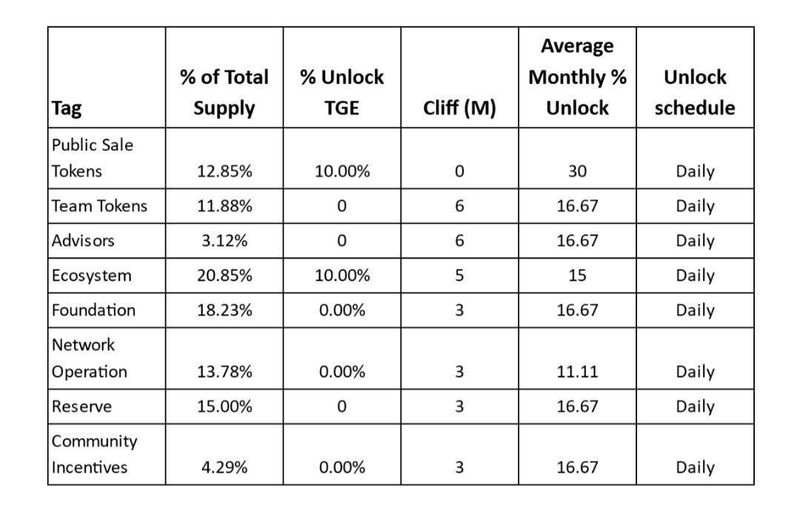
Qubetics tokenomics appears reasonable, primarily, with several points worth noting. It utilizes a unique dynamic total supply model, where the total token supply is determined once the Qubetics presale is completed. Instead of a preset total supply for the $TICS coin, the project fixes the presale allocation at 12.85% of the total tokens, meaning that however many tokens are sold will represent exactly 12.85% (implying that the total supply will be determined post-sale).
With 505M $TICS tokens sold on the self-hosted crypto launchpad at the time of writing, and a presale token price of 0.13001647, a short calculation shows that the current crypto presale Fully Diluted Marketcap (FDV) is $511M, and the expected market cap at launch could be over $1B. With MultiversX blockchain at $460M, Sei at $860M, and Kaspa at $1.6B market cap, one must ask: is Qubetics now worth more than half a billion dollars? Is that their real economic value even before launching any product? We doubt it.
Another aspect to mention is the vesting schedules. Crypto investors receive a fair vesting mechanism, where they receive 10% of their tokens at the Token Generation Event (TGE) and the remaining 90% within three months. The issue arises with the team and advisors’ $TICS token vesting (15% of the total supply). The maturity process of the layer-1 blockchain will likely take years. However, the team and advisors will start receiving their tokens seven months after $TICS launches, and one year after the token launch, their entire $TICS allocation will be released. A two-year release schedule with a one-year cliff would have been a more reasonable approach.
Qubetics Product Development Status and Testnet Progress
According to Qubetics, a public testnet is live, and several ecosystem components are already in testing. The official website links to a Testnet Block Explorer (TICSScan), a Qubetics IDE for smart contract development, a QubeQode (no-code) platform to support dApp creation, and testnet nodes for validators and delegators. As far as we understand, the crypto wallet has also been developed, and, as mentioned earlier, Certik has started the audit process.
To us, the pace of development appears too rapid, given the extensive range of products and features. We are unsure when development began; however, our Google search suggests it started around October 2024. In less than half a year, the pace of growth appears unusually swift given the volume of work accomplished. We are uncertain if this is all proprietary development or if some off-the-shelf solutions were used. We believe that developing such a wide array of complex products using proprietary code should have taken longer, even if, for instance, many developers work simultaneously. The development process is either very impressive, or it might just be another Layer-1 blockchain and custodial wallet lacking a competitive edge.
Qubetics Partnerships, Web3 Integrations, and Collaborations in the Crypto Sector
The Qubetics partnership with Antier for the development of the project infrastructure and products, along with the integration of their wallet with 1inch and SWFT Blockchain, is a positive sign that there is substance behind the product development. This suggests that Qubetics has indeed built a working blockchain environment.
MiCAR Regulatory Compliance Considerations for Qubetics Crypto
MiCAR is a significant regulation that we would expect such a major project with a doxxed team to comply with. However, the whitepaper is missing many relevant disclaimers and information required by cryptocurrency regulations. In our opinion, this regulatory gap casts a shadow on the crypto project and places it under potential regulatory risk.
Blockchain Smart Contract Audit Status for Qubetics Presale
In late February, Certik began auditing the Qubetics blockchain testnet version. This is confirmed on the Certik website, and is a positive indicator that the crypto project is actually developing a tangible product. This process is expected to take several months to complete and is likely to align with the company’s target date for launching the Layer-1 blockchain mainnet in Q2 2025.
Conclusion: Is Qubetics Crypto Presale Legit or an Overpriced Investment?
We don't think Qubetics is a scam. The crypto project appears to be developing a real ecosystem with several products. However, with an inflated FDV, a CEO with no prior relevant experience, a marketing strategy that aligns with questionable crypto projects, and non-compliance with key regulatory legislation, we believe Qubetics is likely an overpriced ICO investment opportunity.
FQA
Qubetics crypto is a Layer-1 blockchain and Web3 multi-chain aggregator project developing the $TICS token. It is designed to facilitate cross-chain interoperability and support the tokenization of digital assets.
During the Qubetics crypto presale, early investors have the opportunity to purchase $TICS tokens before the platform’s official launch. The process works through a self-hosted crypto launchpad where tokens are sold at a predetermined price. The crypto presale is structured with a fixed allocation percentage for early buyers and includes vesting schedules to mitigate inflation risk. Additionally, a portion of the tokens is reserved for the team, advisors, and ongoing ecosystem development, aiming to promote long-term market stability and support sustainable growth within the digital asset market.