The DeepSnitch AI ($DSNT) presale launched in early 2026 and, according to the official website, has raised $2.35 million to date. The crypto presale is positioned as an AI-powered intelligence platform built around the DSNT token, with claims of advanced data analysis and monitoring tools designed for crypto traders, investors, and analysts.
The concept behind DeepSnitch AI centers on using artificial intelligence to track, analyze, and surface insights from large volumes of digital data. The project is described as a tool that provides users with actionable intelligence by combining AI technology with blockchain infrastructure and token-based incentives.
At a time when artificial intelligence continues to attract strong investor attention across both traditional markets and the cryptocurrency sector, DeepSnitch AI appears to be riding that trend. The project suggests it can offer a competitive advantage through AI-driven insights, although the exact implementation and technical details remain a key point of review.
This comes as the broader crypto market shows signs of slowing down, with capital inflows into new crypto presales becoming more limited than in previous cycles. Despite this, the DeepSnitch AI presale continues to attract retail investors, raising questions about what is driving interest and whether the fundamentals support the momentum.
We reviewed the DeepSnitch AI presale, including its whitepaper, tokenomics, team transparency, and product claims, to assess whether DSNT represents a legitimate AI crypto project or a potential scam.
Want to see how similar crypto presales performed after listing? Check out our crypto presales price tracker.
DeepSnitch AI Whitepaper Analysis: AI Claims, Token Utility, and Whether the Document Explains a Real Product
The DeepSnitch AI whitepaper presents the project as an AI-powered intelligence platform that analyzes large datasets and delivers actionable insights via the DSNT token ecosystem. The document focuses heavily on the narrative of combining artificial intelligence with blockchain. However, several gaps and issues appear when examining the document in detail:
- Lack of clarity around data sources and pipelines: The whitepaper explains that DeepSnitch AI will use machine learning models to monitor, process, and interpret data streams. However, it does not clearly explain what type of data is being analyzed, where this data comes from, or how it is collected. There is no detailed breakdown of data pipelines, APIs, or integrations, which are essential components for any real AI analytics platform.
- No technical details about the AI models: The document mentions “advanced AI algorithms” and “real-time intelligence extraction,” but does not specify which models are used. There is no reference to model architecture, training methods, datasets, or infrastructure.
- Unclear justification for the DSNT token utility: The DSNT token is described as a utility asset for accessing platform features, unlocking insights, and participating in the ecosystem. However, the whitepaper does not clearly explain why a blockchain token is required for these functions. Access to AI tools is typically handled through subscription-based systems, and the document does not justify why tokenization improves or enables the product.
- No clear integration between AI and blockchain layers: The whitepaper presents both components, but does not show how they interact meaningfully. There is no explanation of on-chain versus off-chain processing, nor how AI outputs are secured, verified, or stored using blockchain technology.
- Vague roadmap without measurable milestones: The roadmap section inside the whitepaper outlines phases such as platform development, AI integration, and ecosystem expansion. However, it does not include specific milestones, timelines, or deliverables tied to measurable progress. Terms like “launch AI modules” and “expand capabilities” are used without defining what features will actually be released or when.
- Missing system architecture and technical visuals: The document lacks detailed technical diagrams or system architecture visuals. Most sections are written in broad terms, focusing on vision rather than implementation, making it difficult to assess whether the platform is under development or still conceptual.
Overall, the DeepSnitch AI whitepaper provides a high-level overview of an AI crypto project but lacks sufficient technical depth to support its claims. The heavy use of general AI terminology without supporting details suggests that the document is more focused on marketing the idea than explaining how the system works in practice.
DeepSnitch AI Product Development Status: Claimed AI Platform vs Verifiable MVP, Demo, or Working System
The DeepSnitch AI website shows a presale interface where users can connect a wallet and purchase the DSNT token. Beyond this, there is limited publicly accessible functionality that demonstrates the AI platform described in the whitepaper.
At the time of review, there is no open MVP, public beta, or interactive demo that allows users to test the intelligence engine, run queries, or validate AI-driven outputs. The available interface focuses on the token sale rather than product usage.
The team published a development update on February 20, 2026, explaining that the platform had moved into a “fully operational product” and that the network is “live, layered, and ready.” The update described several systems, including an “intelligent caching layer,” expanded asset recognition, and a query engine called SnitchGPT.
The update also mentioned product modules such as Feed, Scan, Audit, Cast, GPT, and Explorer, as well as a “Deep Plus” access layer that unlocks advanced features. The team explained that the system is already “actively serving users” and that the infrastructure is production-ready.
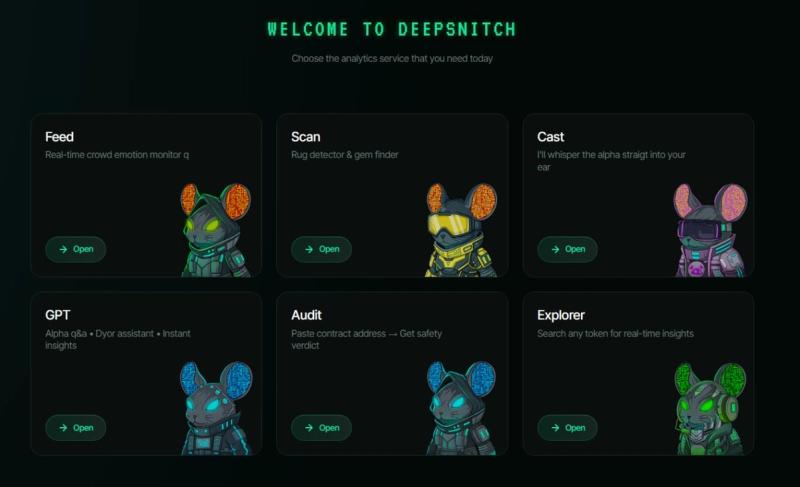
The development update uses strong language such as “production-ready,” “fully operational,” and “actively serving users.” At the same time, it does not provide supporting evidence such as:
- A live application link with functional access
- Demonstrations of the AI system processing real data
- Technical documentation or architecture details
- Independent verification of system performance
SnitchGPT is presented as a system that can answer crypto-related questions using data from the platform. However, there are no example outputs, no interface previews tied to real functionality, and no way to verify whether this system operates beyond description.
There is also no supporting technical evidence, such as GitHub repositories, developer documentation, or system architecture, that would confirm active development of a working AI product.
The gap between the “production-ready” claim and the lack of an accessible product remains a key issue. In most AI or SaaS platforms, even early-stage teams release a limited MVP or controlled demo to demonstrate functionality. In this case, that level of verification is missing.
Overall, DeepSnitch AI presents itself as a live and operational AI platform, but based on publicly available evidence, the product remains unverified. Investors are being asked to fund a system that has not yet been demonstrated in a transparent or testable way.
DeepSnitch AI Team Transparency and Company Structure: Anonymous Team, BVI Entity, and MiCA Compliance Framing
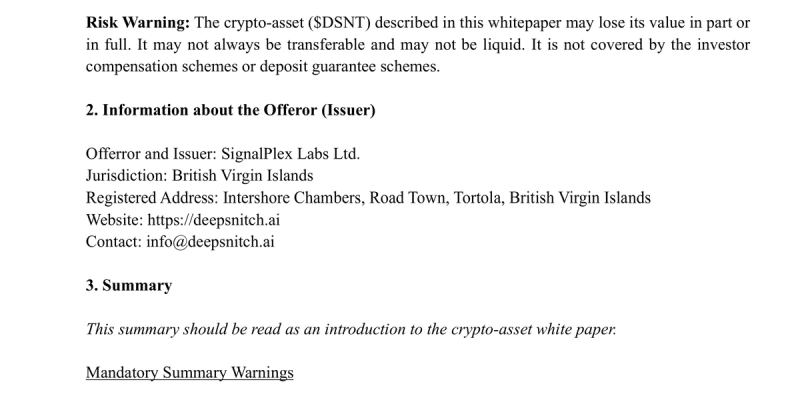
The DeepSnitch AI whitepaper identifies the project’s company as SignalPlex Labs Ltd., a company incorporated in the British Virgin Islands (BVI). The document explains that the entity is responsible for the DSNT token offering and confirms compliance with the European Union’s Crypto-Assets Regulation (MiCA) framework.
However, beyond the company name and registered address in the BVI, the project does not disclose any identifiable individuals associated with the company. There are no named founders, no executive team, and no verifiable contributors presented on the website or in the whitepaper.
The whitepaper includes formal language stating that the management body confirms the information is “fair, clear, and not misleading.” At the same time, it does not reveal who this management body consists of. This creates a situation where accountability is claimed at a company level, but not tied to any real, identifiable people.
The use of a BVI-registered entity is often framed as part of a compliance or legal structure. However, the British Virgin Islands is an offshore jurisdiction where ownership details are not publicly disclosed. This means the individuals controlling SignalPlex Labs Ltd. can remain anonymous.
The whitepaper also does not list advisors, technical leads, or AI specialists involved in building the platform. There are no references to prior experience in machine learning, blockchain analytics, or cybersecurity, despite the project claiming to develop a complex AI-driven intelligence system.
In the risk section, the project itself explains that its success depends on “key technical staff,” yet those individuals are not identified anywhere in the documentation. This creates a disconnect between the stated reliance on expertise and the absence of visible expertise.
For a crypto presale raising over $2 million and claiming to build a multi-agent AI surveillance platform, the lack of team transparency is a critical concern. Investors are asked to trust both the technical execution and fund management without knowing who is responsible.
Across-the-board, DeepSnitch AI combines an offshore company structure with a fully anonymous team. While the whitepaper presents this under a compliance framework, it does not provide meaningful transparency or accountability regarding the people behind the project.
DeepSnitch AI MiCA Compliance Analysis: Structured for Regulation, But Missing Real Transparency
The DeepSnitch AI whitepaper clearly attempts to align with MiCA, a relatively new and important crypto EU regulatory framework. The document includes formal sections such as “Mandatory Legal Disclosures,” risk warnings, and statements confirming compliance with Title II of Regulation (EU) 2023/1114.
At first glance, this structure resembles what regulators expect from crypto-asset issuers operating in Europe. The whitepaper explicitly states that the management body confirms that the information is “fair, clear and not misleading” and includes standard disclaimers about risk, liquidity, and the lack of investor protection.
This is uncommon in many crypto presales. Several projects in recent years have received warnings from regulators such as the UK’s Financial Conduct Authority (FCA), Italy’s CONSOB, and Spain’s CNMV for offering tokens to the public without proper disclosures or compliance frameworks.
DeepSnitch AI appears to be trying to avoid that outcome by structuring its whitepaper to mirror regulatory requirements.
However, when looking beyond the structure, the substance does not fully align with MiCA’s intent.
According to the whitepaper, the entity behind the project, SignalPlex Labs Ltd., is incorporated in the British Virgin Islands. This is an offshore jurisdiction where ownership and control structures are not publicly disclosed.
As a result, there is no visibility into who is actually responsible for development, operations, or fund management.
MiCA is designed to increase transparency, accountability, and investor protection. It expects clear identification of the issuer, responsible individuals, and accurate disclosures that allow investors to assess risk.
In this case, the whitepaper includes formal language about compliance but does not provide the most basic element of transparency: the team’s identity.
The document refers to a “management body” that confirms the accuracy of the whitepaper, but does not name any individuals. This creates a situation in which responsibility is claimed but not assigned to identifiable people.
There are also inconsistencies between the regulatory framing in the whitepaper and the project’s actual behavior.
The whitepaper repeatedly emphasizes that the DSNT token is not an investment, does not provide profit rights, and may have no value or functionality at all. These statements are aligned with legal risk mitigation under MiCA.
At the same time, external marketing campaigns promote the token with aggressive return expectations, including 100x to 1000x upside scenarios. This creates a disconnect between the token’s legal positioning and how it is marketed to investors.
Another issue is the flexibility retained by the issuer. The whitepaper states that the project may modify features, tokenomics, or functionality at its discretion, and that the final product may differ from what is described.
While this is disclosed as a risk, it weakens the reliability of the commitments made in the document.
MiCA aims to provide clarity and reduce uncertainty for investors. In this case, the whitepaper introduces multiple layers of uncertainty while still presenting itself as compliant.
The result is a document that appears structured for regulatory alignment but does not fully deliver the transparency and accountability that regulation is meant to enforce.
DeepSnitch AI’s approach to MiCA compliance shows an understanding of regulatory expectations at a formal level. However, key elements such as team disclosure, verifiable accountability, and consistency between legal disclaimers and marketing remain unresolved.
This creates a clear gap between compliance in form and compliance in substance.
DeepSnitch AI Tokenomics Breakdown and FDV Analysis: $45.77M Valuation Before Launch and What It Means for DSNT Token Holders
The DeepSnitch AI presale is structured around the DSNT token. According to the DeepSnitch AI whitepaper, the token distribution includes:
- 35% for presale participants
- 30% allocated to marketing
- 10% to staking rewards
- 10% to development
- 10% to liquidity
- 5% to the team and advisors
Another key concern is the project’s fully diluted valuation (FDV). With a total supply of 1 billion tokens and a current presale price of $0.04577, the implied FDV is $45.77 million before the token is listed on any exchange.
This places DeepSnitch AI in the mid-range of valuations compared to other recent crypto presales. Some projects, such as Solaxy and Pepe Unchained, launched at higher valuations and later dropped significantly after listing.
While DeepSnitch AI is raising funds at a $45.77 million FDV, there is still no publicly accessible MVP, no verifiable AI system, and no clear technical proof that the platform is operational. This creates a mismatch between valuation and demonstrated product maturity.
The vesting structure introduces another important risk. According to the whitepaper, non-staked presale tokens are fully transferable immediately at the Token Generation Event (TGE).
Staked tokens are locked for only 7 days after TGE before becoming fully transferable.
This means a large portion of the token supply can enter circulation almost immediately after launch. While presale investors can choose whether to sell or hold, the structure, combined with presale discounts and bonus allocations, creates strong incentives for early investors to sell once liquidity becomes available, increasing the risk of a price drop.
In addition, promotional campaigns offer bonus allocations of up to 300% extra tokens. This significantly affects the real token distribution. Investors receiving large bonus allocations effectively reduce their average entry price, thereby increasing selling pressure once the token begins trading on exchanges.
The combination of staged pricing, bonus allocations, minimal vesting, and a relatively high starting FDV introduces structural risks. If demand at launch does not meet expectations set during the presale, early participants may seek to exit their positions, increasing downward pressure on the token price.
Overall, the DeepSnitch AI tokenomics present a $45.77 million valuation for a project that has not yet demonstrated a working product. While the FDV is lower than some previous crypto presales, it remains high relative to the current level of transparency, development proof, and product verification.
DeepSnitch AI Marketing Strategy Analysis: Heavy “1000x” Promotion vs Product-Driven Adoption Signals
DeepSnitch AI’s marketing around the DSNT presale is heavily centered on upside potential rather than product verification. Sponsored articles and promotional content repeatedly position the token as the “next crypto to explode,” with claims of 100x to 1000x returns ahead of launch.
These narratives are not subtle. Phrases like “1000x upside expected” and “moonshot” are used to create urgency and push early entry into the presale. Some campaigns also promote bonus structures offering up to 300% extra tokens, further reinforcing a short-term, profit-driven mindset.

At the same time, these promotions present the platform as already “live,” “fully operational,” and “actively used,” with references to AI agents such as SnitchGPT, Token Explorer, and AuditSnitch. However, these claims are not supported by publicly accessible product evidence, creating a gap between marketing and verifiable functionality.
This creates a structural issue. Marketing is not just supporting the product; it is the core driver of demand. When a crypto presale is built around expectations of extreme returns rather than demonstrated utility, investor behavior tends to follow that narrative.
If participants enter with 100x–1000x expectations, the incentive is not long-term platform usage but an early exit at launch. This can create immediate sell pressure once the token becomes tradable, especially if the product is not yet widely adopted or proven.
The presence of large token bonuses and staged pricing further increases this effect. Early buyers accumulate tokens at lower prices with additional allocations, which can amplify selling incentives when liquidity is introduced.
In this context, marketing shifts from communicating a product to manufacturing demand. Instead of showing adoption, usage, or real user activity, the focus is placed on price potential and timing the entry.
To sum up this section, DeepSnitch AI’s marketing strategy raises concerns because it prioritizes speculative returns over product validation. In early-stage crypto projects, sustainable growth typically depends on usage and delivery. When the narrative is dominated by upside promises, it increases the risk that demand is driven by speculation rather than genuine adoption.
DeepSnitch AI Audits, Partnerships, and Roadmap Execution: Token Audit Completed, No Partnerships, and Unverified Delivery Progress
DeepSnitch AI reports that the DSNT token contract has been audited by two firms, SolidProof and Coinsult. These audits focus on the smart contract deployed on-chain and confirm that no critical issues were found, including no minting backdoors or blacklist functions.
However, the scope of these audits is limited. They apply only to the ERC-20 token contract and do not cover the core DeepSnitch AI platform. The AI agents, including SnitchGPT, SnitchScan, and AuditSnitch, operate off-chain and are not part of the audited code.
This means the audits confirm basic token security, but they do not verify whether the AI system works, whether the data pipelines exist, or whether the platform can deliver the functionality described in the whitepaper.
On the partnerships side, DeepSnitch AI has no confirmed collaborations. There are no announced integrations with crypto exchanges, data providers, blockchain analytics firms, or AI infrastructure companies.
The project refers to being built by “expert on-chain analysts,” but no individuals or organizations are named. There are no external entities backing the project or validating its technology.
The absence of partnerships is noteworthy, given that the platform claims to aggregate data from multiple blockchains and social sources. In practice, such systems typically rely on integrations, APIs, or data providers, none of which are disclosed or confirmed.
The roadmap outlines a four-stage development plan. The first stage includes launching SnitchFeed and SnitchScan with support for Ethereum and BNB. The second stage adds SnitchGPT and AuditSnitch, as well as multi-chain expansion. The third stage introduces SnitchCast and predictive analytics, while the fourth stage targets institutional tools such as compliance modules and advanced tracking.
However, the roadmap does not include specific dates, deadlines, or measurable milestones. It is structured in phases but does not define when each phase should be completed or how progress can be verified.
There is also a gap between roadmap expectations and current claims. While the roadmap suggests that core features will be released progressively, recent development updates describe the platform as “fully operational” and “production-ready.”
Despite these claims, there is no publicly accessible product, no live dashboard, and no independent confirmation that any of the roadmap features have been deployed.

Overall, DeepSnitch AI shows partial progress toward securing a basic token audit but lacks transparency in its partnerships and in the verifiable execution of its roadmap. The combination of audited token infrastructure, no external validation, and unproven product delivery leaves key parts of the project unconfirmed.
DeepSnitch AI Final Verdict: Is This a Legit Crypto Presale or a Potential Scam?
DeepSnitch AI has raised $2.35 million and assigns itself a $45.77 million valuation, yet there is still no working product, no public demo, and no verifiable AI system. The team is fully anonymous behind a BVI entity, with no individuals accountable for development or fund management.
The tokenomics increase risk, with 35% of supply sold in the presale, minimal vesting, and bonus allocations that encourage early selling once liquidity goes live. At the same time, marketing heavily pushes 100x–1000x narratives, creating demand driven by speculation rather than actual product usage.
The audits only confirm the token contract, not the platform. There are no partnerships, no integrations, and no external validation of the technology. The roadmap has no dates or evidence of execution, while claims of a live, production-ready system remain unverified.
This is not what a strong, legit AI crypto project looks like. There is no clear proof that DeepSnitch AI is a scam, but there is also no evidence that it is a legitimate, functioning product. Based on the available information, this is a high-risk presale built on hype, with multiple red flags and a strong likelihood that early investors will exit at launch if real adoption does not follow.