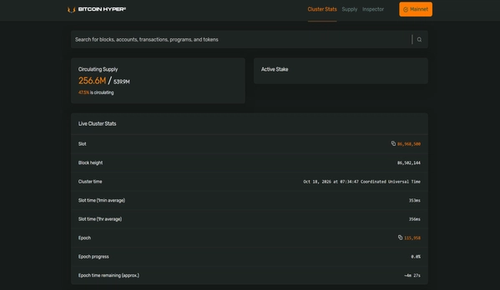
Spain’s financial regulator, the Comisión Nacional del Mercado de Valores (CNMV), issued a public warning on Bitcoin Hyper ($HYPER), a crypto presale project marketing itself as a Bitcoin Layer-2 solution.
The notice, dated 19 January 2026, says that the project and related entities are not authorized to provide crypto-asset services in Spain. The CNMV supervises securities markets, investment services, and, under EU law, crypto activity, and has the power to warn the public when firms operate without approval.
The warning lists five brand names, companies, and websites: bitcoinhyper.com, bitcoinhyper.ltd, BITCOIN HYPER, SENTINUM LTD, and BITCOINHYPER LTD.
It warns that these names are not authorized to carry out activities reserved for crypto-asset service providers (CASPs) under the EU’s Markets in Crypto-Assets Regulation (MiCA / MiCAR), Regulation (EU) 2023/1114.

What MiCA (MiCAR) Is and Why It Matters for Crypto Presales in the EU
MiCA is the European Union’s crypto regulation framework. It sets rules for crypto-asset issuers and CASPs across all EU member states.
It establishes mandatory requirements for public offers of crypto-assets, including detailed whitepaper and disclosure obligations for issuers, and it sets authorization, governance, capital, and conduct rules for crypto-asset service providers (CASPs).
It also introduces specific frameworks for stablecoins, marketing communications, safeguarding of client assets, and market abuse in crypto markets. Depending on the activity, companies may need to publish a compliant whitepaper, notify regulators, or obtain prior authorization before operating in the EU.
For crypto presales, MiCA is especially relevant. If a project publicly offers tokens to EU investors, it may need to publish a compliant whitepaper and notify regulators. If it provides additional services such as custody, exchange, or staking, it may fall under CASP rules and require authorization.
This is the legal framework behind the CNMV’s warning on Bitcoin Hyper.
CNMV Warning on Bitcoin Hyper ($HYPER) and Its Offshore Entities
The CNMV is Spain’s competent authority under MiCA. That means it monitors whether crypto projects that market to Spanish residents comply with EU rules. If a company is not authorized or has not complied with MiCA requirements, the CNMV can issue a public warning. That is what happened in the case of Bitcoin Hyper.
The CNMV did not call Bitcoin Hyper a scam. It said the listed entities are not authorized to carry out activities reserved for CASPs under MiCA. For Spanish investors, that means there is no regulatory supervision or investor protection for this project.
What Is Bitcoin Hyper and the Lack of Public Response
Bitcoin Hyper is a Bitcoin Layer-2 designed for faster transactions and smart-contract-style applications. It is selling the $HYPER token in a crypto presale with branding that mixes infrastructure claims and meme coin-style visuals, which is common in presale marketing.
According to the project’s whitepaper, Bitcoin Hyper is owned by a British Virgin Islands (BVI) entity called Sentinum LTD. Offshore entities are common in crypto projects, and they are often used to hide the project’s real owners and developers, who can remain anonymous behind the entity’s veil.
As of publication, Bitcoin Hyper has not published a public response to the CNMV warning.