Key Takeaways
- • The ZKP crypto presale launched in November 2025 and claims over $2 million raised, while also saying $100 million was self-funded, a claim that remains unverified.
- • The project is run by a completely anonymous team, despite claims that 40 specialists are developing the platform.
- • The ZKP whitepaper mainly explains existing zero-knowledge proof technology rather than clearly describing a unique blockchain implementation.
- • The project shows a testnet and Proof Pod devices, but there is no independent verification that the infrastructure works as claimed.
- • The $ZKP presale relies heavily on marketing, including sports sponsorships, referral programs, and promotional campaigns.
- • The ZKP token and platform have no publicly verified third-party security audit.
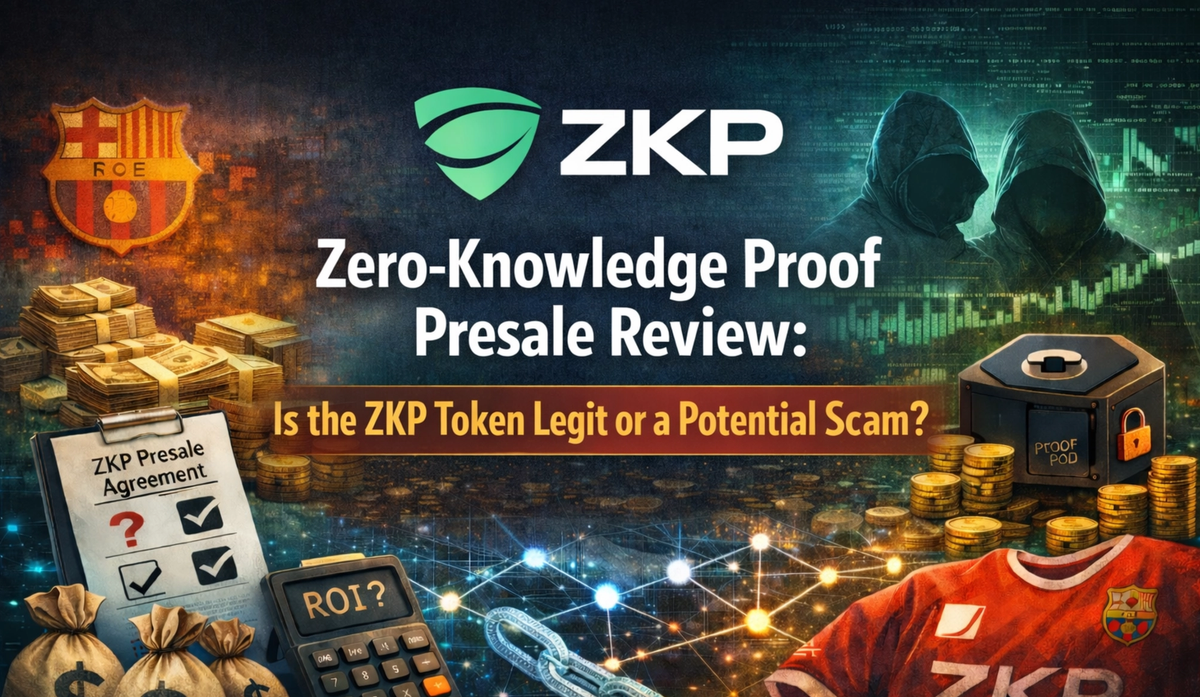
The Zero-Knowledge Proof (ZKP) crypto presale launched on November 27, 2025, and promotes itself as a blockchain project focused on privacy and cryptographic verification. According to the official presale website, the project has raised over $2 million from investors, while a project press release claims the company has already self-funded more than $100 million to support development.
The concept behind the ZKP project centers on zero-knowledge proof technology, a cryptographic method used in blockchain systems to verify information without revealing the underlying data. According to the project’s materials and whitepaper, the $ZKP token is intended to support network operations, transactions, and applications built on the platform.
However, the ZKP presale has attracted controversy from the start. Members of the crypto community and a blockchain investigator claim that the project may be linked to Gurhan Kiziloz, the founder of BlockDAG Network, a project that raised hundreds of millions of dollars and later faced widespread criticism and scam allegations.
A high-profile FC Barcelona sponsorship deal involving the ZKP project, which the club later canceled while denying any official affiliation, added to the controversy.
With questions surrounding the legitimacy of the ZKP presale, we examined the project’s claims, development progress, team transparency, and tokenomics to determine whether it represents a legitimate crypto venture or a potential scam.
ZKP Whitepaper Review: What the Zero Knowledge Proof Whitepaper Actually Shows
The ZKP whitepaper is a long, technical document that explains the architecture behind the ZKP crypto project. Much of the paper is written in dense technical language and includes mathematical formulas related to zero-knowledge proof cryptography, verification systems, and blockchain scalability concepts.
At first glance, the document appears to be a highly technical research paper. It describes how the ZKP blockchain platform intends to use zero-knowledge proofs to verify transactions without revealing sensitive data. This approach is already widely used across the crypto industry in projects building zk-rollups, privacy protocols, and Layer-2 scaling solutions.
The writing style also resembles the BlockDAG whitepaper that circulated during the BlockDAG presale. That document similarly relied on long technical explanations and mathematical expressions to present the project as a complex research initiative. Because of these similarities, it becomes difficult to determine how much of the ZKP whitepaper content represents original research versus explanations of existing cryptographic methods.
Another point that stands out is the absence of named authors or researchers responsible for writing the document. In many serious technical whitepapers, especially those proposing new cryptographic systems, the researchers or engineers behind the work are clearly identified, but not in the ZKP whitepaper.
Another limitation is the lack of clear technical implementation details. While the document explains how zero-knowledge proofs work in theory, it provides fewer concrete details about the actual ZKP blockchain architecture, development repository, or prototype implementation.
Overall, the ZKP whitepaper reads more like a general explanation of zero-knowledge proof technology than a detailed technical specification for a new blockchain platform. Much of the content describes existing cryptographic concepts already used across the crypto industry, while providing limited information on what makes the ZKP blockchain or the $ZKP token ecosystem technically different.
Without clearly identified authors, implementation details, or publicly available development work, it becomes difficult to determine whether the document describes a functioning technology or simply outlines theoretical concepts.
Team Behind the Zero Knowledge Proof (ZKP) Presale
The ZKP presale is run by a completely anonymous team. The project does not disclose the founders, developers, executives, or advisors on its website, whitepaper, or social media channels.
Instead of identifying the team, the project claims the identities will be revealed on June 1, 2026. The explanation given is that the team is hiding their identities “on the blockchain” or for security reasons related to the project. For a crypto presale raising public funds, this level of anonymity is a major transparency issue.
The ZKP roadmap claims that a “core team of 40 specialists” was assembled during the first half of 2025. However, our checks did not find any professionals publicly associated with the project. None of the supposed team members mention ZKP on their LinkedIn profiles, either as current or past experience. The project also does not have an official LinkedIn company page, which is unusual for a project claiming such a large team.
There are also suspicions of links between the ZKP presale and the BlockDAG Network. Members of the BlockDAG community have pointed to similarities between the two projects and suggested that Gurhan Kiziloz, the founder associated with BlockDAG, may be involved.
Blockchain investigator Jerry O’Callaghan conducted an on-chain investigation and reported alleged evidence that funds from the ZKP and BlockDAG presales are being funneled into the same destination wallets. If accurate, this would suggest the two projects may be operated by the same group.
The two projects also share several similarities. Both released highly technical analytical whitepapers, which is uncommon for typical crypto presales. Both rely heavily on sports sponsorships while showing no meaningful technological partnerships, and both appear to use the same marketing agency.
These similarities raise the possibility that Gurhan Kiziloz could be behind the ZKP project. If that is the case, his history with controversial crypto presales would be another red flag. However, there is no confirmed proof at this time, and the connection cannot be stated with certainty.
Product Development Status of the ZKP Blockchain and Testnet Infrastructure
With $100 million supposedly invested in the project, the ZKP presale claims the technology behind the ZKP blockchain network is already built and operational.
The project claims in a press release:
“The blockchain is already live. The compute layer is operational. Storage, execution, and cryptographic verification are in place. Proof Pods actively safeguard uptime. This means participants are not betting on delivery. They are participating in price discovery for a system that already exists.”
(https://coinomedia.com/zkp-100m-self-funded-network-targets-a-1-7b-presale-auction-as-early-window-stays-open)
This description implies the ZKP blockchain network is already functioning, which would place the project far ahead of most crypto presales that typically launch before a working product exists.
However, the project does not provide verifiable proof that this $100 million investment was made, or that the funds were used primarily for blockchain development, research, and infrastructure rather than marketing or promotional activities.
From the website, users can access the ZKP testnet, which includes several tools and interfaces that appear to be functioning.
These tools include:
- a block explorer showing network transactions
- a faucet distributing testnet tokens
- a decentralized exchange swap interface
- The ZKP IDE development environment
- a liquidity pool interface for viewing token pairs and adding liquidity
At first glance, this gives the impression of a working blockchain ecosystem already deployed on testnet.
However, all of these tools appear very basic in design and functionality. While this could be reasonable for an early development stage, there is no way to verify whether these tools were developed internally by the ZKP team or rely on existing off-the-shelf blockchain frameworks or open-source components.
It is also impossible to confirm whether the testnet is powered by a decentralized node infrastructure, as claimed, or whether the backend relies on centralized servers or a traditional database architecture.

Another element promoted by the project is the Proof Pod hardware device, which sells for $249 and is supposed to generate ZKP tokens by producing cryptographic proofs for the network.
According to the project, these devices help secure the blockchain and participate in the zero-knowledge proof verification infrastructure.
However, we did not find independent technical demonstrations, open benchmarks, or third-party verification showing that the Proof Pods actually perform these functions in a live environment.
Perhaps the most surprising element is that, despite claiming $100 million of internal investment and proprietary blockchain technology, the project has not presented external technical reviews from recognized blockchain researchers, cryptography experts, or independent security analysts.
If a team truly developed new blockchain infrastructure based on zero-knowledge proof technology, external technical validation would normally be one of the first steps to establish credibility within the crypto industry.
Taken together, the unverified $100 million investment claim, the absence of external technical reviews, the unclear backend architecture of the testnet, and the lack of proof that the Proof Pods perform meaningful cryptographic work make it difficult to independently verify the true development status of the ZKP blockchain network.
These factors make it challenging to determine how much of the system is currently operational versus conceptual.
Why Conduct a Large Presale if $100 Million Was Already Self-Funded?
If $100 million has already been deployed into the project, the need for a presale becomes unclear. Presales are often used to raise early funding from the public for development. In the ZKP presale case, however, the project claims that the blockchain network is already built and operational, which raises questions about why a prolonged presale is still necessary.
If the goal is to create awareness or build a community, there are many other ways to achieve that without conducting a prolonged public fundraising campaign.
For ZKP, an Initial DEX Offering (IDO) or Initial Exchange Offering (IEO) would normally be the preferred approach. These fundraising methods usually take place later, closer to the token launch, and are often completed within days rather than running for extended presale periods.
Aggressive Marketing Campaign: Crypto Presale, Sports Sponsorships, Referral Programs, and Promotional Campaigns
The Zero Knowledge Proof crypto presale is supported by a large marketing campaign that combines sports sponsorships, referral rewards, giveaways, press-release distribution, and constant presale promotion.
The project presents itself as a platform built on zero-knowledge cryptography, but much of the visible messaging promotes the ZKP token presale, early access to tokens, and potential gains ahead of exchange listings.
FC Barcelona Sponsorship Announcement and Later Termination of the ZKP Partnership
One of the most visible promotional moves was the FC Barcelona sponsorship announcement in November 2025. FC Barcelona introduced Zero Knowledge Proof as an official cryptographic protocol partner. The announcement circulated widely across crypto websites and sports media, placing the ZKP brand alongside one of the world’s largest football clubs.
However, less than two weeks later, the club published a clarification explaining that FC Barcelona had no connection to the ZKP token and that the token issuance was not part of the sponsorship agreement. At the end of December 2025, the club terminated the agreement after compliance and legal reviews concluded that actions related to the project did not comply with the partnership’s terms.
Dolphins NRL Partnership and Use of Sports Branding in ZKP Marketing
The project also announced a partnership with the Dolphins NRL rugby team in Australia, which introduced ZKP as an official blockchain partner. The collaboration described potential applications of blockchain analytics, AI data processing, and fan engagement tools for sports organizations. The announcement focused on branding exposure and future use cases rather than on an existing deployed blockchain product.
The ZKP Presale Marketing Funnel: Referral Program, Presale Stages, Giveaway, and ROI Calculator
Most of the ZKP marketing activity focuses on the token presale funnel. The project website repeatedly promotes presale rounds, stage pricing, and urgency messaging, encouraging investors to join before prices increase. The platform also runs a referral program in which buyers earn commissions when new participants purchase ZKP tokens through their referral links. This structure effectively turns presale buyers into promoters of the project.
The marketing campaign also includes a $5 million giveaway promotion featured on the main website and promoted across social channels. In addition, the site provides a presale ROI calculator that estimates the potential value of purchased ZKP tokens at the time of a future exchange listing. The calculator models different presale scenarios and projected token values based on early participation.

Press Release Distribution, Crypto Media Promotion, and Limited Team Transparency in the ZKP Project
Large volumes of ZKP promotional content also appear across press-release distribution networks and crypto media websites. Many articles repeat similar language about presale fundraising milestones, expected listings, and token demand. The content often resembles syndicated promotional material rather than independent analysis of the technology.
The project’s marketing visibility contrasts with the limited transparency about the team. The ZKP website explains that the full team will be revealed later and that the project prefers to build credibility through delivered technology rather than personal branding. However, the project is simultaneously conducting a large crypto presale campaign supported by sports sponsorship branding, referral incentives, and extensive promotional coverage.
Overall, the marketing around the $ZKP presale focuses on token sales, presale participation, and expectations for exchange listings. Sports partnerships, referral rewards, giveaways, and syndicated PR campaigns appear to be the main tools used to attract attention and drive participation in the ZKP token sale.
ZKP Tokenomics and Supply Distribution
According to the project’s tokenomics, the ZKP token has a fixed total supply of 257 billion tokens.
Of this supply:
- 55% (141 billion) is allocated to Proof Pod mining rewards
- 35% (90 billion) is distributed through the ZKP crypto presale
- 4% (10 billion) is allocated to ecosystem development
- 3% (8 billion) is reserved for liquidity
- 3% (8 billion) is allocated to team and advisor incentives
At launch, the project states that 50% of purchased tokens will unlock immediately, while the remaining 50% will vest gradually over five months, beginning in the second month after launch.
From a structural perspective, the ZKP tokenomics places the majority of future token issuance within the Proof Pod reward system, meaning a significant portion of the circulating supply will depend on the adoption and operation of these hardware devices.
Because the majority of the token supply is tied to the Proof Pod reward system, control over this infrastructure could effectively translate into control over a large portion of the ZKP token issuance.
Without independent verification that the network is decentralized and operated by independent participants, it remains possible that a small group could influence the rate at which new tokens enter circulation.

Security Audits and Smart Contract Verification of the Zero Knowledge Proof ($ZKP) Token and Blockchain Platform
Security audits are a common step for crypto projects launching a token. Independent blockchain security firms usually review smart contracts that control token minting, supply limits, presale allocations, vesting schedules, and governance permissions.
For the Zero Knowledge Proof crypto presale, we did not find a publicly available smart contract audit for the $ZKP token, the ZKP presale contract, or the broader ZKP blockchain platform. The project website does not link to an external audit report, and we did not find audits published by major blockchain security firms such as CertiK or Hacken.
The ZKP website mentions audited contract templates and a bug bounty program for the ZKP testnet, where users can report vulnerabilities. Bug bounty programs can help identify issues, but they are not a substitute for a completed smart contract security audit.
Overall, we did not find evidence that the $ZKP token, the ZKP presale mechanism, or the Zero Knowledge Proof blockchain infrastructure has undergone a publicly verifiable third-party audit. For a crypto presale raising funds ahead of a token launch, a full independent audit from a reputable blockchain security firm would go a long way toward demonstrating that the ZKP platform and token contracts are secure and legitimate.
Red Flags Identified in the ZKP Crypto Presale
| Category | Project Claim | Independent Verification |
|---|---|---|
| Internal Funding | $100M invested | No verifiable proof provided |
| Blockchain Status | Network already operational | Not independently verified |
| Team | “40 specialists” building the project | No team identities disclosed |
| Security Audit | Smart contract verified | No third-party audit found |
| Technology | New blockchain using zero-knowledge proofs | Whitepaper mostly explains existing ZKP concepts |
| Proof Pod Hardware | Devices generate cryptographic proofs for the network | No independent technical validation found |
| Sports Partnerships | Major partnerships including FC Barcelona | FC Barcelona later terminated the agreement |
Conclusion: Is ZKP a Legitimate Project or Another Crypto Scam?
The available evidence surrounding the ZKP presale raises multiple unresolved concerns. The project operates with a fully anonymous team, claims more than $100 million in internal development funding without verifiable proof, and has not published a recognized third-party security audit of its token or platform.
Although the project provides a testnet interface and promotes a hardware-based Proof Pod system, there is currently no independent verification that the underlying infrastructure or technology functions as described. At the same time, the presale is supported by an extensive marketing campaign involving sports sponsorships, referral incentives, giveaways, and widespread press-release distribution.
Taken together, these factors make it difficult to independently verify the ZKP blockchain network’s actual development status or the credibility of the project’s claims.
The similarities with the BlockDAG presale, including comparable marketing tactics, technical presentation, and reported wallet links, have also raised questions about whether the same group could be involved.
With an anonymous team, unverified development claims, similarities to the BlockDAG presale, and multiple unresolved red flags, the ZKP project’s credibility remains highly questionable. Until clear evidence of legitimate development and transparent leadership emerges, investors would be wise to stay away.