What is an IDO?
An Initial DEX Offering (IDO) is a crypto fundraising method where a blockchain project sells its tokens directly to investors through a decentralized exchange (DEX). Instead of raising funds on a centralized platform, the token sale takes place through liquidity pools and smart contracts, allowing investors to buy the token and often trade it shortly after launch.
In the cryptocurrency industry, projects often raise capital before launching their product. These fundraising events help finance development, marketing, and ecosystem growth. Over time, several models have emerged, including Initial Coin Offerings (ICOs), Initial Exchange Offerings (IEOs), and the more recent IDO model.
IDOs became popular during the rise of decentralized finance (DeFi) because they allow crypto projects to launch tokens in a more decentralized way. Instead of relying on a centralized exchange or a project website, the token sale is usually conducted through a crypto launchpad or decentralized exchange, where investors can participate using their crypto wallets.
How Does an IDO Work?
An IDO token sale is typically conducted through a crypto launchpad or decentralized exchange. The process usually follows several steps.
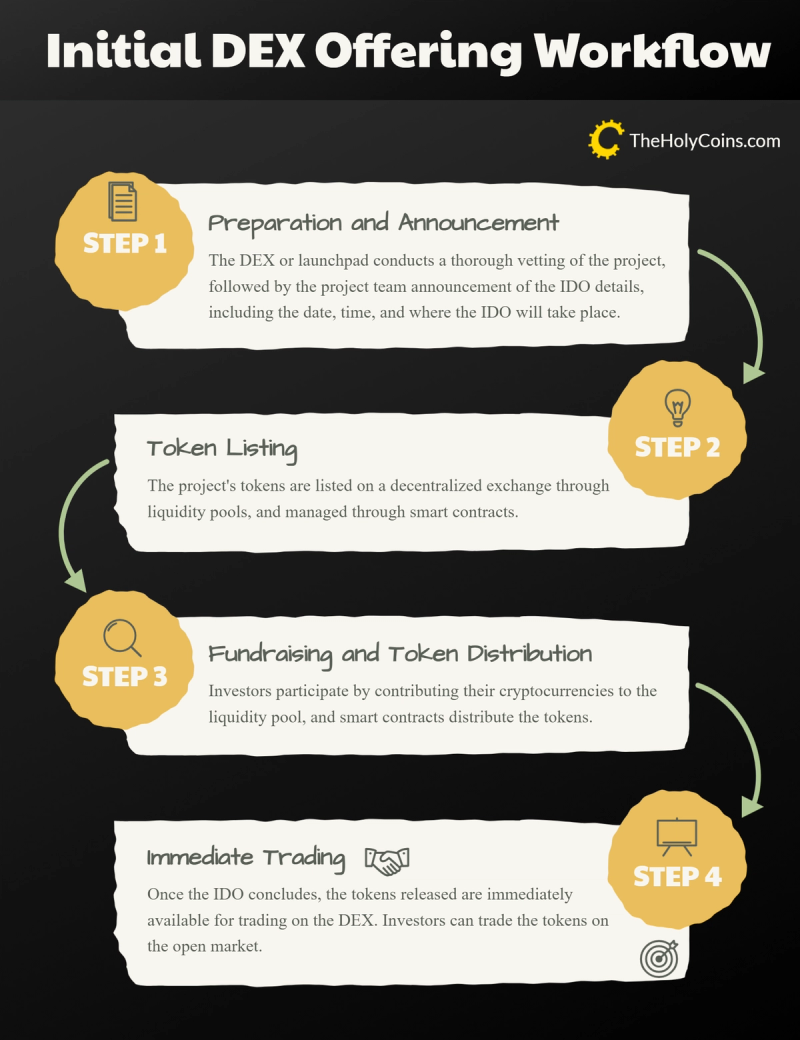
1. Preparation and Announcement:
- Due Diligence and Setup: Before the token sale begins, the project partners with a crypto launchpad or decentralized exchange that will host the IDO. They conduct a thorough review of the project, including the team's background, project goals, and whether the project appears trustworthy.
- Announcement: The project publicly announces the IDO token sale, including the launch date, participation requirements, supported wallets, and the DEX where the token will be listed.
2. Token Listing:
- Liquidity Pools: A liquidity pool is created on the decentralized exchange where the new token is paired with another cryptocurrency, such as Ethereum or stablecoins.
- Smart Contracts: Smart contracts manage the IDO process and ensure that tokens are distributed automatically according to predefined rules.
3. Fundraising and Token Distribution:
- Contribution: Crypto investors participate in IDOs through wallets on launchpads or decentralized exchanges. Some platforms require users to stake launchpad tokens or join a whitelist before participating.
- Token Distribution: Participants receive tokens based on the allocation rules defined in the smart contract.
- Transparency: Because transactions occur on the blockchain, contributions and token distribution can be publicly verified on the blockchain ledger.
4. Trading After IDO:
- Post-IDO Liquidity: Once the token sale ends, investors who have claimed their tokens according to the vesting schedule can trade them on the decentralized exchange through liquidity pools.
- Market Trading: Investors can buy or sell the token on the open market, where the price is determined by supply and demand.
- Price Volatility: Newly launched tokens often experience strong price volatility, which is common for early-stage crypto projects.
Advantages of IDOs
Why are IDOs popular? They offer several advantages compared to ICOs and other crypto fundraising methods.
- Immediate Liquidity: Because the token is launched on a decentralized exchange, trading can begin shortly after the IDO ends. This allows crypto investors to buy and sell the token quickly through DEX liquidity pools.
- Due Diligence: Some crypto launchpads perform due diligence on projects before hosting an IDO to safeguard their reputation and community, which, in turn, can help increase trust in the project, though the level of review can vary.
- Open Access: IDOs allow projects to raise funds directly through crypto launchpads and decentralized exchanges, without needing approval from centralized exchanges. This makes it easier for new crypto projects to launch token sales.
- Transparency: The IDO process is managed by smart contracts, and transactions are recorded on the blockchain. This allows anyone to verify token distribution and contributions, which also means a lower chance of fraudulent activities and scams, as well as a fairer distribution of tokens.
- Lower Costs: Compared to traditional fundraising or exchange listings, IDOs can be more cost-efficient because they rely on automated smart contracts and decentralized infrastructure.
Risks of IDOs
Even though IDOs offer several advantages, they also involve important risks that investors should understand before participating.
- Regulatory Uncertainty: Regulations surrounding IDOs, decentralized exchanges, and crypto token sales are many times vague in many jurisdictions. Governments and financial regulators continue to examine how these fundraising models should be supervised, which could lead to legal or compliance challenges for projects and investors.
- Security Vulnerabilities: Because IDOs rely heavily on smart contracts, code vulnerabilities can expose projects and investors to exploits. Smart contract audits by reputable security firms can help reduce these risks, but they do not guarantee complete protection.
- Vesting Periods: Some IDO tokens are distributed according to a vesting schedule, so investors cannot immediately sell them. If the token price declines during the vesting period, investors may be unable to exit their position.
- Complex Participation Requirements: Many IDO launchpads require investors to buy and stake launchpad tokens, join a whitelist, or meet other eligibility requirements before participating in the token sale. These steps can make participation more complex for new investors.
- Scams and Rug Pulls: As with many early-stage crypto investments, some projects launched through IDOs may turn out to be scams or abandoned projects. Investors should carefully research the team, tokenomics, product development, and smart contract audits before investing.
How to Participate in an IDO
Participating in an IDO usually requires a few preparation steps. Here is how the process typically works.
- Create a Crypto Wallet: To join an IDO, you first need a cryptocurrency wallet that supports the blockchain where the token sale is happening. Popular wallets include browser and mobile wallets that let you connect directly to decentralized exchanges and crypto launchpads.
- Fund Your Wallet with Cryptocurrency: You will need cryptocurrency such as ETH, BNB, or stablecoins to participate in the IDO token sale. These funds are used to purchase the new token and to pay blockchain transaction fees.
- Choose an IDO Launchpad: Most IDOs are hosted on launchpad platforms. Launchpads organize the token sale, manage investor allocations, and provide the interface for participating in the IDO. Before joining, review the project details, tokenomics, and participation rules.
- Complete Whitelist or Staking Requirements: Many IDO platforms require users to join a whitelist or stake launchpad tokens before participating. This process helps control demand and allocate tokens fairly among investors.
- Connect Your Wallet and Join the Token Sale: When the IDO token sale begins, connect your crypto wallet to the launchpad or decentralized exchange. Then submit your contribution according to the sale rules and confirm the transaction on the blockchain.
- Claim Your Tokens: After the IDO ends, participants can usually claim their tokens through the launchpad interface. Some projects distribute tokens immediately, while others use a vesting schedule in which tokens unlock over time.
- Trade the Token on a Decentralized Exchange: Once liquidity is added to the DEX liquidity pool, the token becomes tradable on the decentralized exchange. Investors can then buy, sell, or hold the token depending on market conditions.
IDO vs ICO vs IEO
Crypto projects can raise funds through several types of token sales, with the most common being ICOs, IEOs, and IDOs. While all three methods allow blockchain projects to sell tokens to investors before or during launch, they differ in where the sale takes place and how the tokens are distributed.
| Feature | ICO | IDO | IEO |
|---|---|---|---|
| Where the sale happens | Project website or platform | Crypto launchpad | Centralized crypto exchange |
| Platform control | Managed by the project team | Managed by a crypto launchpad and smart contracts | Managed by a centralized exchange |
| Investor participation | Investors send crypto directly to the project | Investors connect crypto wallets to a launchpad or DEX | Investors participate through exchange accounts |
| Token listing | Listing often happens later on exchanges | Token can trade on the DEX shortly after the IDO | Token usually lists on the hosting exchange |
| Liquidity | Trading usually begins only after exchange listing | Provided through DEX liquidity pools | Provided by the exchange after listing |
| Accessibility | Open to most investors | Requires a crypto wallet and sometimes whitelist or staking | Requires exchange account and sometimes KYC |
| Risk level | High due to limited oversight | Varies depending on the launchpad and project | Moderate because exchanges vet projects |
Popular IDO Platforms
Initial DEX Offerings usually take place through crypto launchpads and decentralized exchanges. Launchpads organize token sales and manage investor participation, while decentralized exchanges provide liquidity and enable token trading after the IDO.
Decentralized Exchanges
- Uniswap: Uniswap is one of the most widely used decentralized exchanges. While it is not specifically an IDO launchpad, many projects add liquidity to Uniswap after a token sale, allowing investors to trade the new token through liquidity pools.
- PancakeSwap: PancakeSwap is a popular decentralized exchange built on the BNB Chain. It is known for lower transaction fees and fast execution times, making it a common platform for trading newly launched tokens.
Crypto Launchpads
- Kommunitas: A decentralized crowdfunding platform for Web3 projects that supports multiple blockchains, including Ethereum, BNB Chain, Polygon, Solana, Avalanche, and Fantom. One special feature of Kommunitas is its tierless allocation system, which allows all token holders to participate in project sales.
- Polkastarter: A crypto launchpad designed for cross-chain token pools and auctions, helping blockchain projects raise funds through decentralized token sales.
- BSCPad: BSCPad focuses on projects launching on the BNB Chain. It uses a tiered staking system that allows investors to gain guaranteed allocations in IDO token sales.
Why should you care about IDOs?
Initial DEX Offerings are one of the main ways new cryptocurrency projects raise funds and distribute tokens to early investors. Many blockchain startups use IDO token sales on crypto launchpads and decentralized exchanges to launch their tokens before they become widely available on the market.
For investors, understanding how IDOs, ICOs, and IEOs work can help when evaluating early-stage crypto projects. Participating in an IDO may provide access to new tokens at an early stage, but it also requires careful research into the team, tokenomics, and project development.
Conclusion
Initial DEX Offerings have become a common fundraising method in the cryptocurrency industry. By using decentralized exchanges and smart contracts, IDOs allow projects to distribute tokens and provide liquidity without relying on centralized intermediaries.
However, like other crypto token sales, IDOs carry risks, including project failure, market volatility, and potential scams. Investors should always review the project’s whitepaper, team, tokenomics, and security audits before participating in an IDO.