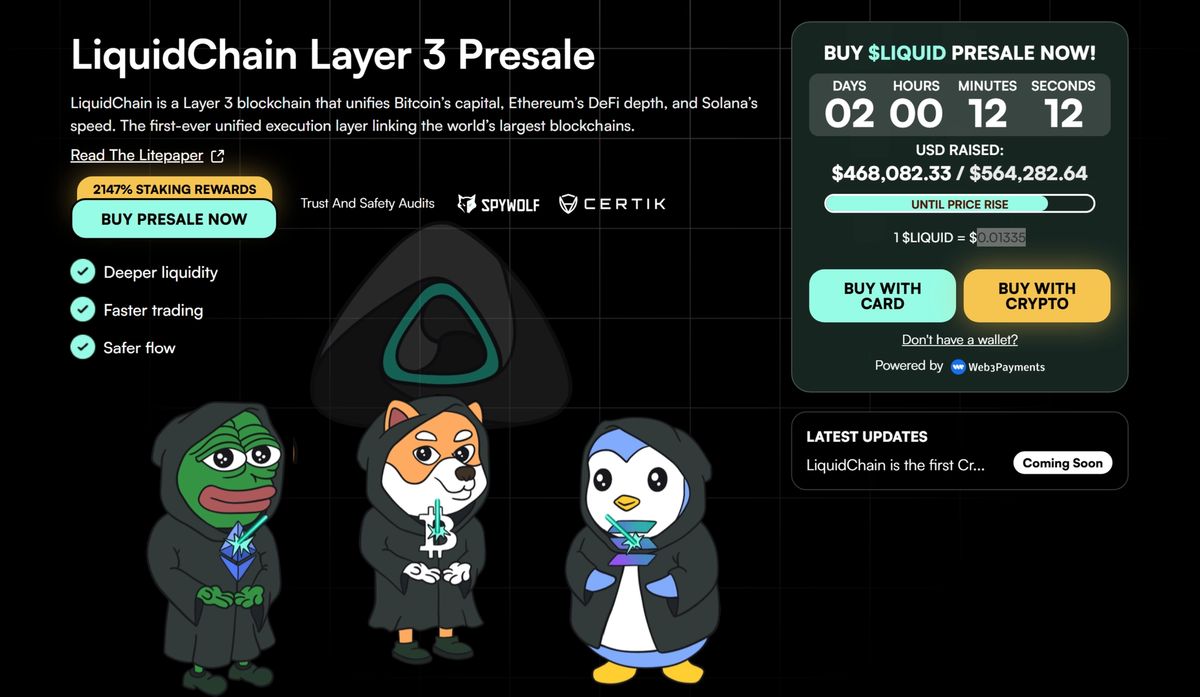
The LiquidChain presale started in November 2025 and has raised $610,000 for its LIQUID token to date. The crypto project is positioning itself as a Layer-3 protocol designed to unify liquidity across Bitcoin, Ethereum, and Solana into a single execution environment.
While the concept sounds highly DeFi-oriented and technically ambitious, and could theoretically support cross-chain capital efficiency, the presale is progressing slowly, and the LIQUID token does not attract the same attention seen in meme coin presales or aggressive hype cycles.
We decided to examine whether LiquidChain has the foundations of a serious crypto infrastructure project, or whether it resembles many other presales that promise complex technology but struggle to justify their valuation and credibility before launch.
LiquidChain Whitepaper and Litepaper Review: Ambitious Claims, Weak Practical Clarity
The 12-page LiquidChain whitepaper presents a Layer-3 architecture and the main components that are supposed to build the platform. However, all the information remains at a conceptual level, without technical specifications or architectural depth.
What is also missing is clarity about execution. The document does not explain in concrete terms how much of this system is already built, how much relies on third-party infrastructure, or what parts are proprietary. It is unclear whether LiquidChain plans to build core components in-house or rely mostly on off-the-shelf interoperability frameworks.
The whitepaper reads more like a mix of slogans, buzzwords, and visual presentation rather than a technical or operational document. This is not what one would expect from a project trying to raise millions from investors.
Additionally, LiquidChain publishes a separate “technical litepaper” on GitBook that uses dense architectural terminology to describe a Solana VM execution layer, cross-domain proofs, and integrations with protocols such as Wormhole, Axelar, and LayerZero.
While this document appears highly technical, it still does not answer the practical questions left open by the whitepaper: what is already built, what is proprietary, what is planned for development, and how the raised funds will be used to reach that architecture.
For a project raising millions from retail investors, the absence of detailed implementation planning, budgeting, and development milestones creates significant uncertainty.

LiquidChain Tokenomics: Presale Allocation, Vesting, and LIQUID Token Distribution
LiquidChain has a total supply of 11,800,000,100 LIQUID tokens, allocated as follows:
- Development: 35%
- Marketing: 32.5%
- Treasury: 15%
- Rewards: 10%
- Listings: 7.5%
What is not clearly disclosed is how many tokens are reserved specifically for the LiquidChain presale versus how many remain under project control.
This structure allows the project to sell tokens continuously without defining a clear presale allocation cap, a pattern increasingly seen in recent presales where teams effectively sell as many tokens as possible rather than committing to a fixed distribution. Without a transparent vesting schedule for the team, marketing, and treasury allocations, investors cannot assess how much token supply could enter circulation after listing.
The heavy marketing and rewards allocation, combined with high staking APYs (in the thousands of percent), suggest that token distribution is being used primarily as a growth tool rather than to drive product adoption.
LiquidChain Team: Anonymous Developers and the Zestura LLC BVI Structure
The LiquidChain whitepaper names Zestura LLC, based in the British Virgin Islands, as the company behind the project and lists a managing director named Adrian Wei. Beyond that, the development team remains anonymous, with no verifiable identities, LinkedIn profiles, or KYC validation by a reputable third party.
An anonymous team raising millions in a crypto presale is always a point of caution. While anonymity is not uncommon in crypto, it becomes harder to justify when large public funds are being raised for infrastructure development without any product and at high token valuations.
Bottom line: the current structure allows the project to operate without personal accountability if it fails or underdelivers.
LiquidChain Token Audit: What CertiK and SpyWolf Checked, and What They Didn’t
LiquidChain’s ERC-20 token and presale contract were audited by CertiK and SpyWolf, and both audits found no critical vulnerabilities. The token does not contain minting backdoors, honeypot mechanics, or blacklist functions, which is an important positive sign for presale safety.
However, these audits only cover the token functionality. They do not validate the Layer-3 architecture, cross-chain logic, or the core technology that LiquidChain is raising funds to build. Modern crypto presales rarely fail due to token contract exploits; failures typically stem from the non-delivery of the promised product.
The audits prove the token is technically safe to buy, but they do not prove the project can deliver what it claims.
LiquidChain FDV and LIQUID Token Price: $157M Valuation Before Launch
Investors buying into the LiquidChain presale today are effectively valuing the project at a fully diluted valuation (FDV) of $167.5 million, calculated by multiplying the total supply (11.8B) by the current price ($0.0142). If the token lists around $0.016, the launch FDV would be $189 million.
These valuations are typically associated with established startups with products, revenue, or strong teams. Here, investors are assigning that valuation to a presale with no working product, an anonymous team, and no decent early conceptual whitepaper.
Such a starting valuation leaves significant room for downside given the risk involved.
Aggressive Marketing: 13,000% APY Claims, and Influencer Promotion
LiquidChain’s marketing is aggressive. The project is widely featured across crypto news outlets, affiliate blogs, and YouTube channels known for promoting presales, and many of these articles appear on sites that are part of or connected to the Clickout Media publishing network. The marketing emphasizes the cross-chain narrative and the extremely high staking APY offered during the LiquidChain presale.
The use of thousands-percent APY as a primary attraction is a pattern frequently seen in presales that rely on token inflation rather than product adoption. While not inherently malicious, this shifts the focus away from technology and toward yield farming as the main selling point.
Marketing patterns like these have appeared in many presales that were later widely criticized and labeled as scams after launch.

The marketing effort appears far more developed, widespread, and funded than the level of technical transparency presented in the whitepaper, and the overall project coverage is overwhelmingly promotional rather than organic.
MiCAR Compliance: Disclaimers Without Regulatory Transparency
When reading the LiquidChain whitepaper, it is clear that the document includes elements that resemble requirements seen under the MiCAR regulation. The presence of legal disclaimers, issuer details, and even a 14-day refund policy gives the impression that the project is positioning itself as regulation-aware.
It is always encouraging to see crypto projects acknowledge regulatory frameworks. However, in this case, the effort appears superficial. While certain visible elements are present, the level of disclosure and transparency required under MiCAR is clearly missing:
- No full disclosure of the team or responsible parties
- No detailed financial or operational transparency
- No clear breakdown of how the raised funds will be used
- Registration in the BVI rather than a regulated EU jurisdiction
The documentation creates the appearance of regulatory awareness without meeting the MiCAR standard.
Is LiquidChain Legit? Final Verdict on the LIQUID Token Presale
LiquidChain presents an interesting cross-chain liquidity concept supported by modern interoperability ideas. However, the lack of execution transparency, anonymous team structure, high valuation, vague whitepaper implementation, and marketing-heavy approach create a combination of red flags that cannot be ignored.
The LIQUID token is technically safe, but the project itself remains largely conceptual. Investors are asked to assign a nine-figure valuation to a team they do not know, building a system that does not yet exist, based on documentation that lacks operational depth.
A serious crypto infrastructure project would emphasize proven development, transparent team accountability, and measurable progress before raising at this scale. LiquidChain emphasizes marketing, token rewards, and conceptual architecture instead.
This pattern is not new. In recent years, many crypto presales with similar characteristics, such as anonymous teams, conceptual whitepapers, and aggressive marketing, some of which were later exposed as scams, have seen their tokens drop 80%–90% shortly after launch, as market pricing replaces presale expectations.
Our opinion: do not participate in the presale. If you are genuinely interested in the project, it is wiser to wait for the token launch and consider buying it later, likely at a fraction of the presale price.